
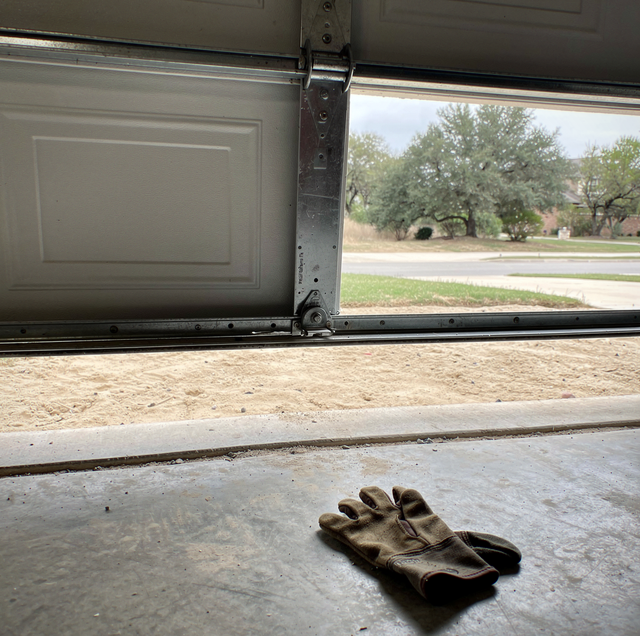
You press the button, the door lifts about six inches, and then it either freezes where it is or drifts right back down. It happens at the exact moment the door would normally settle into a smooth climb, which is what makes the stall worth reading closely: what the door does next narrows the list. The candidates are the force and travel settings in the opener, the springs, the tracks and rollers, the wall control and sensors, and the logic board.
Stops and Stays Where It Is
If the door climbs to about six inches and simply holds there, neither closing nor climbing further, the opener has stopped the motor instead of reversing it. Openers are programmed with an up-travel setting that tells the motor how far the door needs to rise before the cycle is finished, and a separate force setting that tells it how much resistance counts as normal effort versus an obstruction. A door that stalls and holds at the same point each cycle can be a travel or force setting reading the lift wrong. A spring that no longer carries the door's weight, a fixed bind in the track, or a slide-lock bar left thrown stop it at one fixed height on each cycle too, so the sound, the light, and the track described below are what tell those causes apart.
Stops, Then Reverses Back Down
A door that climbs six inches and then drives itself back to the floor is doing something different from one that simply holds. Here the opener is actively reversing, which some openers do when they read too much resistance on the way up. A force setting that reads the door's own weight as resistance can trigger it. So can a door that has become heavier than it should be: a spring that has lost some of its tension hands the opener a jump in load as the lift begins. A roller binding in the track can set it off the same way. Telling them apart takes a closer look at the hardware, since the reversal looks the same for all three.
The Opener Strains or Hums at the Stall
Listen to the motor during the attempt. A door that stops with the opener laboring, groaning, or humming under load at the exact point it quits is showing you a different kind of stall than one that cuts out cleanly and goes quiet. An opener only adds the last few pounds of lift once the springs have balanced the door, so a motor working hard at six inches up can signal the counterbalance is not carrying its share of the load, though a bound roller or a dragging track can make a healthy motor labor the same way. Whether that spring loss is enough to explain the stall by itself, or whether it is adding to a setting or a binding part, is worth checking with a proper balance test rather than guessed at from the sound alone.
The Opener's Light Flashes
Opener models built with a status light on the motor housing or the wall control blink it in a set pattern when a cycle ends in a fault, rather than a normal stop, and the flash count is meant to be read against a code list rather than treated as a mystery. The count narrows the search toward what the opener monitors: the safety sensors, the wall control circuit, and its own force and travel limits, which a heavy door or a binding track can trip. It does not by itself name the part.
Tracks or Rollers Binding
A door can also stall for reasons outside the settings and electronics: something in its physical path is adding resistance at that point in its travel. The top rollers rest just under the radius, the curved piece joining the upright track to the horizontal run, so they enter it within the first several inches of the lift, and a roller changing angle there binds if the track has drifted out of true by even a little. Soil that expands and contracts with moisture can, over time, walk a slab and the frame bolted to it just enough to pull one side of the track out of parallel with the other; on stable soil, that shifting stays slight, and a track out of true there can come from a loosened jamb bracket or an impact instead. Either way, a bind shows up as effort at one spot rather than a clean stop, which is a useful thing to notice before anyone touches a tool.
The Photo-Eye or Wall Control
The photo-eyes mounted low beside the door exist to stop a closing door, so a door that won't finish opening is less likely to be a sensor problem. A wall control can also cause an opening-side stall: a button stuck in its housing, a pinched or damaged low-voltage wire behind the console, or a short in that wiring run can feed the logic board a signal that fights the one the button is sending, which shows up as the door hesitating a few inches into the lift instead of running clean. Confirming which side of the circuit is misbehaving is a job for whoever can test the wiring directly, not something to diagnose by watching the door alone.
| What Happens | What It May Point To | Safe to Check from the Floor |
|---|---|---|
| Stops and holds at the same height | A travel or force setting, a spring short of the door's weight, or a fixed bind | Note the exact height and whether it repeats |
| Stops, then drives back down | A force setting, a spring losing tension, or a bind | Watch whether the light flashes as it reverses |
| Opener labors or hums at the stall | Counterbalance not carrying its share, or a bound roller | Stop pressing the button; don't touch the spring |
| Opener's light flashes as it stalls | Sensors, wall control, or a force or travel limit | Count the flashes and note them for the technician |
| Binding near the curve in the track | Track pulled slightly out of parallel | Look for space around a roller in its rail |
What You Can Safely Look at from the Floor
None of this requires opening the opener housing or going near the spring.
Pattern: note whether the door holds at the same height each time or reverses, and whether that height changes.
Sound: a clean, quiet stop leans toward a setting, a sensor, or a force limit the door's weight has tripped; a straining or grinding motor leans toward the counterbalance or a binding track.
Light: if the opener has a status light, count how many times it flashes and whether the count repeats.
Track: with the door stopped, look along both vertical tracks for a roller wheel riding loose in its channel, or a section of track that looks pulled away from the frame.
A door that stalls early may have a broken or weak spring, so pulling the release cord while it hangs open can let its full weight drop without warning. The spring, cables, and a bent track are a technician's job.
Frequently Asked Questions
It can, when the stall starts right after that work. A replacement spring sized for a lighter door, or wound short, leaves the opener carrying the weight from the first inch of travel, even though the door sits closed, looking normal. Mention the date of the spring job when you book the visit.
Only a fully disconnected one. A trolley that has come loose from the drive mechanism, whether from the emergency-release cord or a worn latch, leaves the chain, belt, or screw turning while the door itself never moves at all, since nothing downstream of the disconnect is pulling it. Six inches of powered travel shows the trolley was engaged when the lift began. A half-caught or cracked trolley can still slip under load, so it narrows the search without ruling the trolley out.
It can. Each attempt that quits leaves the door hanging with a low gap under its bottom edge, one a pet or a small child can slip under, beneath a door that may have lost its spring. One or two tries are enough to see the pattern; after that, keep people, pets, and cars out of the opening until it has been looked at.
A force setting calibrated when the mechanical resistance in the system was at one level can read differently once that resistance shifts, whether from a track that has drifted a little further, a roller that has stiffened, or hardware that has loosened slightly with use. The setting itself hasn't changed, but what it's being asked to judge has, so an intermittent stall can be a sign the resistance is creeping. A loose wire at the wall control or at the sensors comes and goes the same way.
Yes, in the drive section. A screw-drive opener moves a carriage along a threaded rod instead of pulling a chain or belt, so it adds the carriage nut and the drive screw to the list in place of chain or belt slack. The setting, spring, and track apply to it the same way.
Partly. Openers with a connected app can show recent open and close events, which helps a technician match the stall to what the opener logged. That history records when the door moved and stopped, so watching the door run still settles the cause.
Have the stall diagnosed before you keep pressing the button — a technician pins the six-inch stop on the setting, spring, track, or sensor behind it and repairs it safely. Squared Away Garage Door Service serves Cedar Park and Central Texas. Call (512) 456-3781.