
Smart Garage Door Opener vs Traditional: What Really Changes (Copy)
Ask most homeowners what makes a garage door opener "smart," and the answer comes back the same way almost every time: it has an app. Press a button on your phone instead of the wall, get a notification if you forget to close the door, maybe let a delivery driver into the garage. That is the sales pitch, and it is not wrong, but it leaves out the part that actually matters. The app is the layer you interact with. It has nothing to do with whether the opener runs quieter, keeps working through a power outage, or holds up better across a decade of daily cycling. Those differences live in the motor, the circuit board, and, on some models, a built-in camera, none of which care whether your phone can talk to your garage.
Strip the app away entirely and a truly upgraded opener is still a different machine from a traditional one. The comparison worth making is not "app versus no app." It is DC motor versus AC motor, integrated battery backup versus none, and hardware bolted into the opener itself versus a unit that only ever does one job: open and close on command.
The Real Divide Is the Motor, Not the App
A traditional opener runs on an AC induction motor: alternating current, one fixed operating speed, and a fairly abrupt jump to full torque the instant it powers on. There is no in-between state. The motor is either off or running at its single speed, which means the drive belt or chain snaps taut at the start of travel and slams into the limit switch at the end. Every open and close cycle ends the same way, with the trolley and the header bracket absorbing a small jolt.
A DC motor works differently because it is not locked to one speed. Direct current lets an onboard circuit board vary the voltage sent to the motor windings in real time, which means the opener can ramp up gradually instead of snapping to full torque, and ease down before the door actually reaches its fully open or fully closed position. Manufacturers call this soft start and soft stop, and it is a function of the motor and control board working together, not the app. Openers from LiftMaster, Chamberlain, and Genie that carry Wi-Fi connectivity in their mid-to-premium lines are built around this same DC motor platform, so the motor upgrade and the app happen to ship together, but one does not require the other.
The difference in how the two motors start feels a lot like the difference between flooring a car in first gear and easing onto the gas pedal. Both get the car moving. One does it by putting the full jolt of acceleration into the drivetrain at once; the other spreads that same acceleration out so nothing downstream takes a hit all at once. On a garage door, "downstream" means the belt or chain, the trolley, the springs, and the header bracket bolted into the framing above the opening, all of which take that hit every single cycle for as long as the opener is in service.
Battery Backup Went From an Add-On to Standard Equipment
Most traditional AC-motor openers ship with no backup power at all. If a homeowner wants one, the usual path is buying a separate accessory battery module after the fact and having it wired into the existing control board, an add-on rather than something the opener came with. DC-motor smart openers, by contrast, increasingly ship with an integrated backup battery as standard equipment, built into the opener housing at the factory and wired directly to the control board rather than retrofitted later.
It is worth separating two storm-related failures that get lumped together, because a battery backup only solves one of them. A power surge during a storm can damage the logic board's circuitry outright, and no battery backup protects against that; that failure needs surge protection at the outlet or a board repair. A plain loss of power, the outage itself, is the other failure, and that is exactly where integrated battery capacity earns its place: the motor and control board switch over automatically, and the door keeps opening and closing on the wall button and any paired remote already in range, no waiting on the utility company to restore service before the car can get out of the garage.
Cameras and Motion Sensors Live in the Opener, Not the Phone
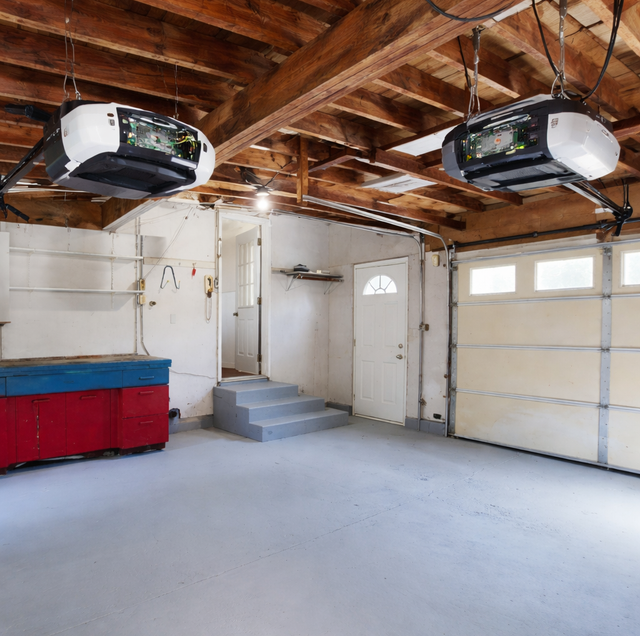
Every opener sold today, traditional or smart, ships with a photo-eye sensor pair mounted near the floor on both sides of the track, wired into the safety circuit that reverses the door if something breaks the beam. That part is not new and has nothing to do with this comparison. What some smart openers add on top of that is different hardware entirely: a camera lens and a motion sensor built into the opener head itself, aimed down at the driveway or the bay below, capturing a clip every time the door cycles or something moves through the sensor's range.
The lens is fixed in place and does not pan or tilt, so its field of view is whatever sits directly beneath the opener: the bay, the parked car, and the first few feet of driveway past the threshold, not the street or the yard. That hardware, the lens and the motion sensor together, is physically absent from a traditional opener. No app update or firmware push adds it after the fact; it has to be built into the unit from the start.
Standard Opener vs Smart Opener: A Side-by-Side Look
| Feature | Traditional Opener (AC Motor) | Smart Opener (DC Motor) |
|---|---|---|
| Motor type | AC induction, single fixed speed | DC permanent-magnet, variable speed |
| Start and stop behavior | Hard start, hard stop at each travel limit | Soft start, soft stop ramped by the circuit board |
| Operating noise | Louder, especially at the start and end of travel | Quieter at each end of travel; usually paired with a belt drive, which accounts for much of the rest |
| Battery backup | Aftermarket accessory only, if added later | Often built in as standard equipment |
| Camera or motion hardware | Not available on the unit | Available on select models |
| Works without a network connection | Yes, by design; nothing on it needs one | Wall button and paired remote still work; app and notifications do not |
What the Motor Difference Feels Like Over Years, Not Days
A garage that doubles as the main entry into the house typically racks up far more open and close cycles than a side door or a rarely used bay, and every one of those cycles is a small mechanical event for the belt or chain, the trolley, and the torsion or extension springs carrying the door's weight. An AC motor's abrupt start and stop turns each of those thousands of cycles into a slightly harder jolt than it needs to be; a DC motor's ramped start and stop spreads the same work over a longer curve, which is gentler on the parts taking the load.
Temperature swings compound that wear in both directions, not just one. Cold mornings thicken the lubricant on the rail and the springs, so the motor has to overcome more resistance the instant it starts, which is a worse moment for a motor that jumps straight to full torque. Sustained heat does the opposite kind of damage: it adds thermal stress to the motor windings and accelerates the breakdown of grease and seals, so a motor that spends less time at peak torque during each cycle runs cooler over a full season of that heat. Neither extreme is the whole story on its own; both push the same components toward the same kind of fatigue over the life of the opener.
None of this touches the door's mechanical alignment, which is a separate system entirely. A motor upgrade, DC or otherwise, does not correct a track that has drifted out of true because the slab underneath it has shifted, and it will not quiet a door that is shaking because a roller has worn out. Motor type changes how the opener drives the door; it does not change what shape the track and rollers are in.
The Network Connection Is Its Own Piece of Hardware to Secure
A Wi-Fi-connected opener adds something a traditional opener never had to think about: a device on your home network that can open a physical door, and that device needs the same basic account hygiene as anything else connected to the internet. The realistic risk isn't a stranger cracking the door's encryption: it's a reused or weak account password, a router still running its factory admin login, or an old phone with the app still installed and logged in after it's sold or handed down. Any of those gives someone the same access as the homeowner, without touching the opener itself.
The practical defenses are the same ones that protect any smart-home account: a unique password on the opener's app account rather than one reused elsewhere, two-factor authentication where the manufacturer offers it, and removing old devices and shared users from the account when a phone is replaced, or a household member moves out. Firmware updates matter here too, in a way they don't on a traditional opener: manufacturers periodically patch the connected unit's software to close vulnerabilities, and an opener that never updates is running whatever security existed the day it was installed. On models with a built-in camera, the same account controls also gate who can pull up stored footage of the driveway or garage, which is worth factoring in separately from the door-access question itself.
When a Traditional Opener Still Makes Sense
Not every garage needs the upgrade to earn its keep. A detached workshop, a rarely used second bay, or a door that one person operates a handful of times a week does not generate the cycle count where soft start and soft stop make a noticeable difference, and it usually has no real need for shared access, an activity log, or a camera watching an already-quiet space. A traditional AC-motor opener does the one job it is built for reliably, and a low-cycle door with a single user is not the situation where the extra hardware goes to work.
The households and garages that get the most out of the DC motor and its accompanying hardware are the opposite case: a garage functioning as the household's main entry, high daily cycle counts, more than one person needing access, or a location where an outage-proof door matters more than convenience. Matching the motor to how the door actually gets used, not the marketing around it, is the real decision.
Frequently Asked Questions
No, and connectivity is not even a reliable signal of which motor is inside the housing. Some DC-motor openers ship with no wireless radio at all, and app control gets added to plenty of AC-motor openers through a retrofit hub that wires into the existing terminals and changes nothing about how the motor drives the door. The line on a spec sheet worth reading is the motor description, DC or permanent-magnet versus AC induction, along with whether a battery-backup port is listed at all. Those two details say more about how the opener will run and sound than any of the connectivity bullets printed above them.
In many cases, yes, though the bolt-on route carries limits the integrated version does not. Manufacturers commonly spec an accessory battery at roughly twenty full open-and-close cycles in the first 24 hours of an outage, after which it needs hours back on utility power before it is ready again. It generally powers the opener alone rather than anything else wired to it, and the battery is a wear item with its own replacement schedule, usually a few years in, well before the opener itself is finished.
No, and the bigger difference isn't coverage but when each one is recording. Opener cameras are event-driven: a clip starts when the door cycles or when the unit's own motion sensor trips, so anything happening in the bay that triggers neither one may never be captured at all, where a dedicated exterior camera runs on continuous or motion-zone recording. Night behavior differs too. An opener camera works off built-in infrared illumination inside a closed garage rather than an exterior camera's floodlight, which produces a usable black-and-white picture of the bay and very little detail past the door opening.
Barely, and not for the reason the packaging implies. Most residential openers move the door somewhere in the range of six to eight inches per second, and the premium DC models manufacturers market as faster sit at the top of that band rather than in a different class, which works out to a second or two on a seven-foot door. What a DC motor actually changes is the shape of the curve at each end of the trip: it spends the first and last stretch of travel ramping instead of running flat out, so the average across a full cycle lands closer to the AC opener's than the marketing suggests.
No. The battery sits inside the opener's housing and charges off the same standard grounded outlet the opener already plugs into for normal operation. No separate wiring, subpanel, or dedicated circuit is needed for the backup to charge and stand ready.
No. The soft-start and soft-stop ramp values are set in the motor's control board during manufacturing, not downloaded or maintained through an ongoing cloud connection, so there is nothing for a discontinued app or a deleted account to switch off. The integrated battery backup behaves the same way: it charges and discharges through the opener's own circuitry, with no dependency on a live account to keep functioning.
The real question when weighing this upgrade is not which opener is smarter. It is which motor, and which hardware built around that motor, actually matches how often your door cycles and what happens on the other side of it when the power goes out.
Compare a traditional opener replacement against a DC-motor upgrade for your garage — a quick look at your current setup shows which hardware actually fits how you use the door. Squared Away Garage Door Service serves Cedar Park and Central Texas. Call (512) 456-3781.
