Warning Signs of a Failing Garage Door Spring (Before It Snaps)
You press the button, the opener whines, and the door crawls up halfway before giving up. Or you lift the door by hand, and it feels like it weighs three hundred pounds. In most cases, the part failing is not the opener or the tracks. It is spring, and a spring is one part of a garage door that can hurt you.
What the Spring Actually Does
A garage door panel section can weigh well over a hundred pounds, and a full double door far more. You are not lifting that weight when you raise the door by hand, and neither is the opener motor. The springs carry it.
There are two common setups. A torsion spring sits on a metal shaft mounted horizontally above the door opening and winds tightly to store energy. Extension springs run along the horizontal tracks on either side and stretch instead. Either way, the job is the same: the spring counterbalances the door's weight so that the door is nearly weightless in motion. The opener and your arm only ever move a few pounds of net force. When a spring weakens or breaks, that balance is gone, and the full weight lands somewhere it should not.
Think of the spring like a spotter holding most of the barbell while you guide the bar. The moment the spotter lets go, you are suddenly holding everything, and you were never set up to catch that load. A garage door opener is in the same position when a spring fails.
The Warning Signs, in Order of How Often People Notice Them
The door feels very heavy to lift by hand: This is the clearest early sign. With the opener disconnected, a healthy door lifts with light effort. A door that fights you or feels dead-weight is telling you the spring has lost tension.
The opener struggles, strains, or opens the door only partway: An opener is built to guide a balanced door, not to haul a heavy one. When you hear the motor labor, or the door rises a foot or two and stops, the opener is trying to make up for a spring that is no longer pulling its share.
The door drops fast or slams shut instead of settling gently. A balanced door eases down. One that comes down hard, or free-falls the last stretch, has lost the counterweight that should be slowing it.
A loud bang from the garage: A torsion spring under full tension releasing all at once makes a sharp report that people often mistake for a gunshot or something heavy falling. If you heard that sound and the door stopped working afterward, the spring is the first suspect.
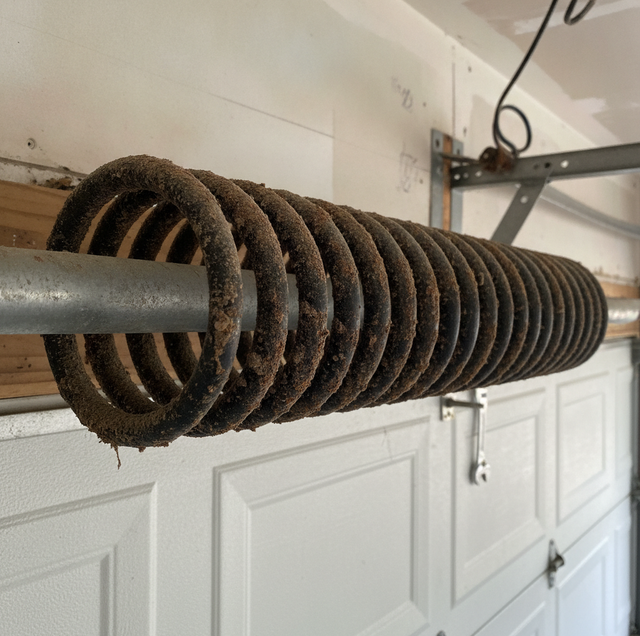
A visible gap in the torsion spring coil: Walk out and look at the shaft above the door. A healthy torsion spring is a continuous, tightly wound coil. A broken one shows a clean separation, with the two ends pulled apart.
The door opens crooked, or one side sags: On a two-spring door, if one spring is weaker or broken, that side stops carrying its load, and the door racks out of square as it moves.
Jerky, uneven movement: A door that hitches or lurches rather than gliding is often fighting inconsistent spring tension.
The door won't stay put at waist height: This is the balance test in miniature. A balanced door held partway open stays there. One that slides down on its own has lost spring support.
Rust or obvious wear on the spring: Corroded coils bind together and fatigue faster. In a hot, humid climate, summer humidity speeds surface rust on springs, cables, and hinges, and the same heat that bakes a garage all afternoon keeps the metal cycling through expansion and contraction, so wear accumulates year-round rather than only in one season.
The springs are original and past their service life: Springs are rated by cycles, and once a door has been through its share, failure is a matter of when, not if. If the springs are the ones that came with the house and the door gets daily use, age alone is a warning sign.
Why a Failing Spring Is a Safety Problem, Not Just an Annoyance
When a spring snaps, the counterbalance disappears, and the door's full weight transfers to whatever is still holding it: the opener and the lift cables. Neither is designed to carry that load alone. The opener can burn out. A cable already carrying more than it should can fray and let go. If that happens while the door is up, the door can come down under its own weight with nothing slowing it.
That is why this is different from a squeaky roller or a worn weatherstrip. A spring problem is a structural problem with a heavy moving object over your car, your tools, and sometimes your feet.
How to Tell a Spring Problem From a Track or Roller Problem
Not every misbehaving door is a spring. A quick way to sort it out:
Spring problems show up as weight and balance issues: the door is heavy, it won't hold position, it slams, or you hear a bang. Track and roller problems show up as movement and alignment issues: grinding along one spot, a roller jumped out of the track, the door binding at a specific height, or a bent section of track. If the door glides but derails, look at the track. If the door tracks fine but feels impossibly heavy, look at the spring.
What to Do if You Suspect the Spring
Stop using the door. Every cycle on a failing spring puts more strain on the opener and cables. Do not try to force it open, and do not keep hitting the opener button, hoping it catches.
Do not attempt to replace or adjust the spring yourself. This is the part of a garage door that stores enough energy to cause serious injury, and it is the one repair where the safest possible advice is simply: call a professional. A technician has the winding bars, the correct replacement spring rated for your door, and the training to release and set tension without getting hurt.
One more thing worth knowing before the call: on a two-spring door, both springs are typically replaced together, even if only one broke. The reasoning is in the FAQ below, along with the details on cycle life, the balance test, and what a snapped spring looks like up close.
Frequently Asked Questions
With the door fully down, pull the opener's manual release cord to disconnect the trolley, then lift the door by hand. A balanced door rises smoothly with light effort and stays put on its own when you let go around waist height. A door that feels very heavy, refuses to stay up, or slams back down has lost spring tension. Reconnect the opener afterward, and if the door failed the test, leave it down until it is serviced.
A torsion spring usually breaks with a single loud bang from the garage, sharp enough that people often think a gun went off or something heavy fell. Afterward, when you look at the spring on the shaft above the door, you will see a clean gap of an inch or two in the coil where the two ends have separated and unwound slightly. That visible gap is the clearest confirmation that the spring, and not the opener or tracks, is the failed part.
The spring holds enough wound-up energy that a slip while you are handling it can break bones or cause worse injuries if it releases uncontrolled. Beyond the danger, the job requires specific winding bars and a spring rated to the exact weight and travel of your door, plus the know-how to wind it to the correct number of turns. Guessing at any of those leaves the door either unbalanced or dangerous, which is why spring work stays with a trained technician.
On a two-spring door, yes. The two springs are installed at the same time and share the load equally, so they wear at the same rate. If one has reached the end of its cycle life, the other is right behind it. Replacing them as a matched pair keeps the door balanced, avoids putting a brand-new spring next to a worn-out one, and saves you a second service call within months when the second spring inevitably goes.
Springs are rated in cycles, where one full open plus one close counts as a single cycle. A common rating is around ten thousand cycles, which works out to roughly seven to ten years for an average household that opens the door a few times a day. A home where the door is the main entrance and cycles many times daily will burn through that rating faster, so usage matters more than calendar age alone.
No. Forcing a weak spring can strip the opener's plastic drive gear or overheat its motor, and it dumps the whole load onto the lift cables and the bottom brackets, which aren't rated to carry the door alone. One of those parts failing is what actually drops the door. The safe move is to stop using the door until the spring is replaced, rather than trade one part for several.
Book a spring inspection today — catch a failing spring before it snaps and keep your door safe. Squared Away Garage Door Service serves Cedar Park and Central Texas. Call (512) 456-3781.
