Why Does My Garage Door Get Stuck Halfway?
A door that climbs partway and then quits is one of the more frustrating problems a homeowner runs into: your car is half in, half out, and the opening sits wide open. A door that stalls mid-travel is telling you one of two things. Either something is physically resisting the movement at that point, or the counterbalance system that carries the door's weight has stopped doing its job. Both are common, both have identifiable causes, and both come with the same warning: a door that keeps stopping should not keep being run.
Resistance Or Lost Balance
A door that travels its full path smoothly is riding on good rollers, running in true tracks, and supported by healthy springs that offset almost all of its weight. When it stops halfway, one of those pieces has failed: it has either hit resistance it cannot push through, or lost the counterbalance that lets a small opener motor move a door that can weigh well over a hundred pounds. Which one it is tells you how urgent the repair is. Resistance in a track is a nuisance; a failed spring is a safety matter.
Where The Trouble Usually Lives
Most doors that stick mid-travel do so for one of a handful of reasons, clustered in the tracks, rollers, springs, or the opener's settings.
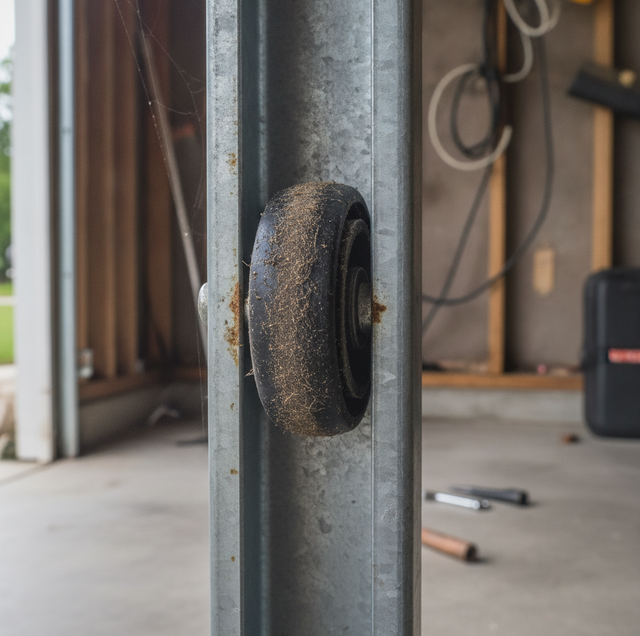
Track trouble is the most visible. A bent, dented, or drifted track creates a pinch point, and the door binds against it at the same place every time. Loose debris does the same on a smaller scale: a stone, a chunk of dried mud, or a screw backed out of a hinge can lodge against a roller and stop it cold. Rollers themselves wear out. A worn, rusted, or flat-spotted roller drags instead of turning, and the added friction can stall a door partway up its run.
Then there is the counterbalance. Most modern doors use a torsion spring on a shaft above the opening; older or lighter doors use extension springs along the horizontal tracks. Either way, those springs store the force that offsets the door's weight. When a torsion spring weakens or breaks, the door suddenly feels its full weight, and the opener, which was only ever sized to nudge a balanced door, raises it a foot or two and stalls against the load. The lift cables that work with the springs can fray or slip off their drums and produce the same crooked, hesitant stall.
Finally, the opener's own settings can be the culprit even when the door is mechanically fine. Every opener has travel and force limits. Set the up-travel limit too short, and the door stops before it should; set the force too low, and the opener reads normal resistance as an obstruction and shuts down mid-lift. Those adjustments drift over time and after power interruptions.
| What You Notice | Likely Cause |
|---|---|
| Stalls at the same spot every time | Bent track or debris at that point |
| Rough, catching, noisy travel | Worn or rusted rollers |
| The door feels heavy and stops soon after starting up | Broken or weakened torsion spring |
| The door goes crooked as it stalls | Frayed cable or track alignment |
| Stops short with no binding, motor sounds fine | The opener travel or force limit is set incorrectly |
When To Stop Running The Door
Here is the part worth taking seriously. A door that stalls once, then works fine after you clear a stone from the track, was probably just obstructed. A door that stops halfway more than once has a real fault, and forcing it turns a small repair into a large one. Springs and cables live under high tension and hold up a heavy door; a spring that is already failing can let go, or a cable can whip loose, if you keep cycling the door against the problem. Stop operating a door that repeatedly stalls, leave it in a safe position, and have it looked at before you use it again.
How Weather Wears On The Hardware
Garage door hardware takes a beating from both ends of the calendar. Long stretches of summer heat and UV bake the lubricant off rollers and hinges and push springs and opener motors harder, while the humid, damp spells the rest of the year drive rust into springs, cables, and roller bearings that then grind instead of glide. Wind-blown dust and grit settle into the tracks year-round and give the rollers something to catch on. None of this changes the basic causes, but parts wear faster than in a dry, mild climate. Wiping the tracks clean, keeping the rollers and springs lightly lubricated, and having the balance checked periodically keeps normal wear from becoming a door that stops halfway.
Frequently Asked Questions
Start with the door fully closed, not open. Pull the manual-release cord, the red handle hanging from the opener rail, only when the door is down, so the panel cannot drop if the trolley disconnects under load. With the door released, lift it by hand to about waist or chest height and let go. A door with sound springs stays roughly where you left it. One that feels heavy, slams down, or drifts open on its own is unbalanced; one that lifts fine but grabs at one spot points to a track or roller rather than the springs. That separates a balance problem from a resistance problem in about a minute.
No. A door caught partway open is the moment you least want to send it back down. If a spring or cable has already given way, the counterbalance is gone, and the panel can drop far faster than the opener intended and crash into whatever, or whoever, is underneath. Keep people and vehicles clear, and do not tap the button again, hoping it corrects itself. If the door is stuck open and will not close on its own, treat the opening as unsafe until a technician has secured it; rather than forcing another cycle, a failed part cannot survive.
Get up close to the stall height on both tracks with a flashlight. A dented section of vertical track shows as a shiny crimp where the wall of the channel has been pushed in. Look for a small stone, a wad of hardened grease, or a hinge screw that has backed out into the roller's path. Check that each roller stem still rides inside its channel; a roller that has hopped out sits cocked at an angle and drags the door sideways. Any one of those, found right at the stall point, is the thing stopping the door.
Follow each lift cable from the bottom bracket at the corner of the door up to the drum near the spring shaft. A sound cable wraps in neat, tight coils around the grooves of the drum. A failing one shows frayed strands, kinks, or a nest of loose wraps, and a snapped one hangs slack or has jumped off the drum. Because the two cables share the load, one letting go drops that corner while the other holds, which is why a bad cable makes the door hang crooked. Cables sit under the same tension as the springs, so inspect them by eye only and leave any replacement to a technician.
That is a different signal from a door that is physically jammed. A steady hum or grind with little movement usually means the motor is trying to lift a load it cannot handle, which points to lost counterbalance, a stripped drive gear, or a seized trolley, rather than a bent track. A door truly stuck on debris tends to stop hard and silently as the opener's force limit trips. Note which one you hear before you call, since a laboring motor and a clean mechanical stop send a technician looking in two different places.
It does, because most stalls are the end of a slow decline, and a periodic tune-up catches early. A service visit checks and adjusts the spring balance so the counterbalance stays matched to the door, lubricates rollers and hinges before dry bearings drag, realigns and tightens tracks so no pinch point forms, and resets the opener's force and travel limits that wander with age and power blips. On a schedule, those small corrections keep the parts that cause halfway stalls from reaching failure, which matters in a climate that swings from lubricant-baking heat to damp, rust-driving stretches.
Reading The Clues Before You Call
A door stuck halfway is never random. Where it stops, how heavy it feels, whether it goes crooked, and whether the motor labors all point toward the cause: track and debris problems stall at a fixed spot, worn rollers make travel rough, a failing torsion spring makes the door feel heavy soon after it starts up, and a mis-set opener stops it short with no real resistance. The balance test sorts the spring question from the rest in about a minute. On any repeated stall, leave the door alone and get it diagnosed, so a minor fix does not become a spring or cable failure.
If your garage door keeps getting stuck halfway, we can find the cause and fix it safely. Squared Away Garage Door Service serves Cedar Park and Central Texas. Call (512) 456-3781.
