What Causes a Garage Door to Come Off Its Track? 8 Culprits
Quick Answer: A garage door comes off its track when something forces a roller out of the channel it rides in, or when the track itself gets bent, loose, or blocked. The usual triggers are a vehicle bump, a snapped lift cable, worn rollers, a misaligned track, an obstruction under the door, a broken spring, or debris in the channel. Stop using the opener and call a technician.
A garage door looks simple from the driveway. It goes up, it goes down, and most days you never think about how. The whole system rests on a small detail: a set of rollers riding inside a steel channel. When those rollers stay in their track, the door glides. When one jumps out, the door goes crooked, binds, and stops sealing against the floor. Sometimes it hangs at an angle, one corner sagging while the other stays put.
Understanding why a door leaves its track matters more than knowing how to muscle it back. The same force that pushed the roller out is often still loaded in the system, and an off-track door can drop. So before anyone reaches for a wrench, it helps to know what actually happened.
How the Track System Actually Works
Each side of the door has a vertical track running up the door frame and a horizontal track running back along the ceiling. Where they meet, a curved section lets the door change direction as it opens. Rollers, usually two to four per door section, sit in stems along the edge of each panel and ride inside these channels. Lift cables and springs carry the weight so the rollers only guide the path, not bear the load.
The door stays on track as long as three things hold true: the rollers are intact, the channel keeps its shape, and both sides move together. Break any one of those, and a roller can find a gap and slip out. That framing explains nearly every cause below.
The Eight Things That Knock a Door Off Track
A vehicle bump or a hard knock: The most direct cause. Backing into a partly open door, clipping it with a bumper, or a heavy object striking a panel can shove a roller sideways hard enough to pop it out of the channel or dent the track so the roller no longer fits. Even a firm push against a lightweight aluminum door can do it if it lands on the wrong spot.
A broken lift cable: Picture a two-person ladder carry where one person suddenly lets go. The load doesn't just drop straight down; it swings and twists toward the side that failed. A garage door behaves the same way. A cable snaps or unwinds off its drum on one side, that corner falls, and the door racks diagonally. The twisting pull yanks the rollers on the failed side out of their channel almost instantly.
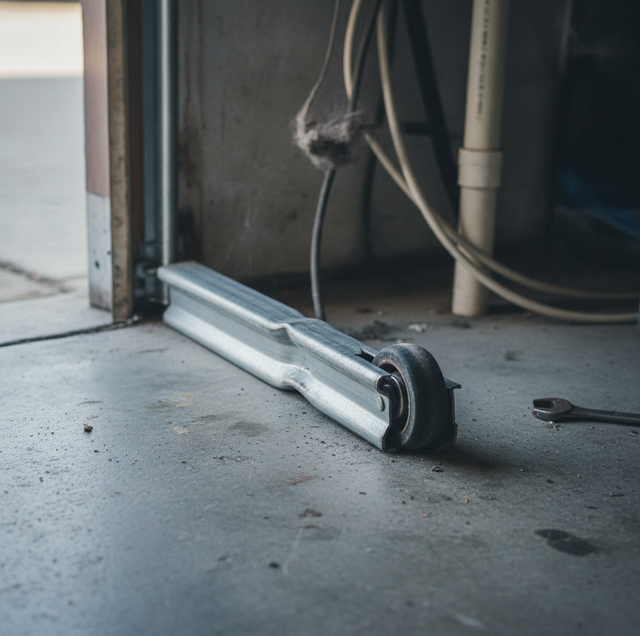
Worn or broken rollers: Rollers wear. The nylon or steel wheel flattens, the bearing seizes, or the stem bends. A roller that no longer spins freely drags rather than rolls, and a dragging roller climbs the channel's side until it rides up and over the lip. Cheap rollers with few bearings tend to fail this way years before the door itself wears out.
Bent, loose, or misaligned track: The track is held to the wall and ceiling by brackets and lag bolts. Over time and use, those fasteners loosen. A track that has drifted out of true, whether from loosening or from a past impact, presents a section where the channel is too wide or angled incorrectly, and a roller reaches that spot and slips free.
An obstruction under the door: A trash can, a stray toy, a bag of mulch, or a warped threshold sitting in the door's path stops the bottom of the door before the panel reaches the floor. If the door keeps trying to close on the object, the bottom rollers get shoved upward and outward, walking right out of the vertical track.
A broken torsion or extension spring: The springs balance the door's weight. When one breaks, the opener or your arms suddenly face the door's full weight, and travel turns uneven and jerky. That jarring, side-loaded motion can walk a roller out of its channel over a single rough cycle.
Debris in the track: A pebble, a wad of packaging, an acorn, or a hardened clump of grease lodged in the channel acts like a speed bump. The roller hits it, stops, and the momentum of the moving door forces the roller up and over the edge instead of through the blockage.
A slam after a spring or cable failure: When a spring or cable lets go while the door is moving, the door can slam down under its own weight. The sudden impact at the bottom of travel jolts the whole assembly and can pop rollers on both sides at once, sometimes bending the lower track in the process.
Why an Off-Track Door Is Not a Wait-and-See Problem
An off-track door has lost part of what holds it in place. Depending on how it left the channel, it may be leaning on a single roller, a bent bracket, or nothing structural at all. That makes it prone to falling, and a garage door section is heavy enough to injure someone or crush whatever is under it.
It also stops doing its job. A door that is not seated squarely will not seal at the bottom, so weather, dust, and pests get in. And there is a trap waiting for anyone who tries to fix it the fast way: pressing the opener button. Forcing a crooked door with the opener does not pull it back into line. It drags the door further out of square, tears more rollers loose, and can bend a straight section of track into a ruined one. A minor single-roller pop can become a full track replacement in a few seconds of button pushing.
Telling One Problem From Another
Not every off-track door is the same job, and reading the scene helps you describe it accurately when you call for help.
A single popped roller usually shows one corner of the door bulging away from the track while the rest sits normally, and the door is otherwise level. This is often the mildest version.
A bent track shows a visible kink, waviness, or a dent in the steel channel, and the roller may sit beside the damage rather than in it. The metal itself looks wrong.
A cable or spring failure looks different. Look for a lift cable hanging loose or coiled on the floor, a door sagging badly on one side, or a torsion spring above the door with a visible gap where the coil has separated. These are the signs that the load-bearing parts let go, and they are the most dangerous of the three.
What You Can Safely Do, and What to Leave Alone
There is a short list of safe steps. If the door is fully down and resting on the floor, and you can see it is supported and not about to move, you can pull the opener's red release cord to disconnect the door from the opener motor. That prevents anyone from accidentally running the opener. Keep your hands and fingers away from the track channels, the rollers, and any part of the door that could shift, and keep kids and pets out of the garage.
That is where the safe list ends. Do not run the opener to test the door. Do not try to lift or shove the door back into its channel by hand; it is heavy, it is under spring tension, and it can slide, pinch, or drop while you wrestle with it. And never, under any circumstances, loosen, adjust, or remove a spring or a lift cable. Torsion and extension springs store enough energy to break bones, and that energy remains even when the door is up or down. Off-track repair, spring work, and cable work all belong to a trained technician with the right tools.
Hot, dusty climates add their own wear to the picture, and it works in both directions rather than only in one season. Summer heat and long, humid stretches accelerate corrosion on cables and rust on cheap rollers, while fine dust and grit blow into the channel year-round and grind against the moving parts. Cooler, drier months slow the corrosion but bring their own gunk as grease stiffens and debris collects. None of this is seasonal in the sense of a one-time event; it is steady, all-year stress that quietly sets up the failures above.
Frequently Asked Questions
No. Once a roller is out of the channel, the opener is pulling on a door that can no longer travel straight, so every push of the button drags it crooked. That force can bend the track, tear more rollers out of their stems, or drop the door entirely. Cut power to the opener at the outlet or breaker and leave the door where it is until a technician arrives.
Yes. Each lift cable holds up one side of the door. When one snaps, that side falls while the other side stays held, and the door twists on the diagonal until the rollers on the failed side are wrenched out of the channel. A cable dangling loose beside the door is a clear signal to keep your hands off it, because the tension that snapped it can still whip the loose end.
When a door closes on an object, the safety reverse is supposed to sense the resistance and send the door back up. If that feature has failed, been disconnected, or was bypassed, the door keeps pressing down on the obstruction instead. The panel goes slack against the object, the tension that keeps the bottom rollers seated eases off, and those rollers walk out of the channel.
Even a door that looks balanced is held by spring tension the opener normally counteracts, so before anyone touches it, the opener's release cord must be pulled with the door DOWN and blocked in place. A raised or partly open off-track door can drop the moment the opener is released, which is exactly why reseating a roller is a pro job despite looking simple. Forcing a roller back in can pinch fingers, slip, or bring a section of the door down on you. The easy-looking part is surrounded by parts that hurt people.
Every open-and-close cycle sends a small vibration through the track and its mounting hardware. Over hundreds of cycles, that vibration slowly loosens the lag bolts and brackets. The track drifts a little further out of alignment each time, and eventually it reaches a point where the channel gaps wide enough for a roller to slip out during normal travel, with no dramatic event to blame.
Often, yes, if the underlying cause is left in place. A bent track, a worn roller, a weakening cable, or a tired spring will keep creating the conditions that pushed the roller out the first time. A proper repair diagnoses and corrects the root cause rather than only reseating the roller, which is the difference between a fix that holds and one that fails again in a few weeks.
Book a technician the moment your door goes crooked — a fast, correct repair keeps a popped roller from turning into a bent track or a dropped door. Squared Away Garage Door Service serves Cedar Park and Central Texas. Call (512) 456-3781.
