
Garage Door Top Bracket Ripped Out: Torn Steel or Just Bent?
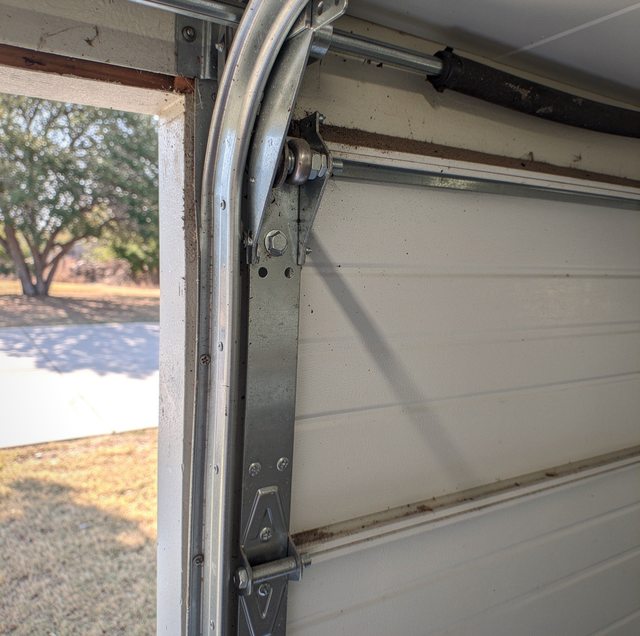
From your driveway, a bent top fixture and a torn one can look like the exact same problem. The top corner of the door sits crooked, there's a gap where the panel should sit flush against the track, and the opener stopped partway through its cycle. Up close, they are not the same repair at all. One is a bracket that folded under load and can usually be swapped for a new one. The other is steel that gave way, and it can take part of the door's own structure with it.
Bent Metal Versus Torn Steel: What Each One Looks Like
The part in question is the top fixture, sometimes called the top roller bracket. It's fastened to the top section, holds the roller that rides in the track's throat, and, on most sectional doors, it's also where the opener's J-arm, through the inner carriage, ties into the door to pull it up and down. It shouldn't be confused with the flag bracket, which anchors the top of each vertical track to the framing, or the header bracket, which mounts the opener's rail to the wall above the opening. Both of those stay fixed to the building. The top fixture is fastened to the door itself and travels with it every cycle.
A cosmetic bend looks like this: the bracket's flange has folded or twisted, the fasteners are still fully seated, the screw heads sit flush, and the paint around them is undisturbed. The roller may sit crooked in the throat, but the steel it's bolted to is intact.
Torn steel looks different. The fastener holes have stretched into ovals or pulled through entirely; there's visible daylight or a jagged edge where the bracket separated from the panel skin, and sometimes a curl of steel comes up with it. A crack in the paint often radiates outward from the tear, following the panel's stamped rib line, which is the finish telling you the metal fatigued before it let go.
Where the Load Concentrates When a Door Won't Give
This kind of tear almost always starts the same way: the opener pulls against a door that will not move. A track jammed with debris, a manual lock still engaged, a roller bound solid in the throat, ice, a section shifted out of square. An opener measures the effort a cycle demands and backs the door off once that effort exceeds what its calibration allows; that calibration was taken from a door moving freely, leaving a wide margin for drag that develops later. A sudden, hard mechanical stop, something bound solid rather than merely stiff, can exceed even a generous setting in the instant before the sensor fully reacts. By then, whichever point in the chain is weakest has already given way, and on most doors, that point is the top fixture. It's a small stamped bracket carrying the full pull of the opener arm, concentrated on one or two fasteners.
How much force actually reaches that bracket also depends on where the door was in its travel when it bound. A torsion spring's torque doesn't reverse direction as the door moves, but its magnitude does change, running highest with the door down and lowest with it up, so a jam near the bottom of a cycle and a jam near the top don't load the top fixture quite the same way.
Don't send the door through another cycle to see how far it gets. With the fixture torn free, nothing ties that corner of the section to the roller in the track, and the top of the panel can swing clear.
A Torn Fastener Hole Versus a Fully Split Stile
Where the tear stops matters as much as where it starts. A torn fastener hole is confined to the panel skin: the sheet steel around the screw has pulled through, but the rest of the skin and the stile behind it are still sound. It's the difference between a shirt button ripped clean through worn fabric and the seam behind it giving way. A split stile is the second case: the vertical member that the fixture is anchored to, the end stile at the edge of the section, has cracked or separated along its length, often taking several inches of skin with it.
That distinction sets the repair scope. A torn hole confined to the skin, with sound steel still available nearby, can often be addressed by setting a backing plate over solid metal so the fastener has something real to bite into. A split stile is a different situation, because the stile is also what the hinges above and below it anchor to, and on some panels it's what the opposite fixture ties back into as well. Hardware alone doesn't fix a structural member that's already given way.
Hardware Damage Versus Damage to the Section Itself
Separating "swap a bracket" from "replace a section" comes down to a handful of things a technician looks at directly: whether the steel around any remaining fastener holes is still sound, whether the hinge line above and below the tear is still straight, whether the panel skin is still flat or has started to bow away from the reinforcement behind it, and whether the tear runs all the way to a corner where two stiles meet, which is a compounding weak point rather than an isolated one.
If the steel nearby is sound, the fixture goes back to work on fresh metal. If the steel is compromised, cracked, or the stile itself has split, hardware has nothing solid left to grip, and the section gets replaced with the fixture transferred over to it.
The Center Stile Can Tear the Same Way, One Bracket Over
Not every door routes the opener's pull through the two top fixtures near the ends of the section. On some doors, the J-arm bolts to a separate bracket mounted on the center stile, the vertical member running down the middle of the panel, rather than tying into either end fixture. Under the same kind of resistance, that mounting can tear out of the center stile exactly the way an end fixture tears out of an end stile.
Because the center stile often carries the section's mid-span reinforcement, this version of the tear tends to appear as an outward bow or a crease running across the width of the panel, in addition to the tear itself. That changes what gets inspected. A center-stile failure puts the fastener point and the panel's flatness across its full width on the same checklist.
What a Technician Checks Before Recommending a Repair
The visual read starts by confirming which failure occurred and where: the flag brackets and header bracket are checked separately to rule out a track or opener-mount problem before assuming the section itself is at fault. From there, a technician looks at how far the fatigue extends past the visible tear, and checks the opposite top fixture and both rollers, because a section that's racked, or twisted slightly out of square, from a one-sided tear often puts new stress on hardware that wasn't part of the original failure. Once the door is confirmed safe to cycle again, the opener's travel and force settings are rechecked, since a hardware swap or a new section doesn't always match the exact geometry those settings were tuned for.
A torn top fixture is sometimes mistaken for a reason to bypass the opener and move the door by hand instead. The release cord is safe to use only with the door fully closed and the counterbalance intact, and it is never a way to hold a door open. With hardware missing from one corner of the door, a technician confirms the counterbalance is still doing its job before anything gets cycled on that door again, by hand or by opener.
The Details Worth Noting Before Anyone Arrives
A torn top fixture rarely gives any warning softer than the tear itself, so it isn't something you're expected to watch for the way a bearing plate or a fraying cable can be. What helps a technician most, before they ever arrive, is a plain description of what happened right after: which corner, whether the opener kept running or stopped immediately, and whether the tear reached the stile. That detail alone often tells a technician which of the two repairs is coming before the truck is even in the driveway.
Frequently Asked Questions
Moving the fixture moves the roller with it, so where that wheel sits in the throat changes. The roller stem gets reset in the fixture's slide at the same time, because a stem left at its old depth holds the door tight against one side of the track.
Not necessarily. The two systems are separate, but the same jam that tore the fixture can also let a cable go slack enough to crowd out of its groove on the cable drum, so a technician checks the drum and cable seating on both sides even when the springs themselves look intact.
From inside, with the door closed, the operator arm is visible all the way to where it meets the top section. An arm landing near the middle of the door's width bolts to a center-stile bracket. One angling out toward a corner ties into a top fixture instead.
The tell is the track itself. If the track is still plumb and the flag bracket anchoring it to the framing hasn't moved, the failure is confined to the section. A track that has pulled away from the wall or gone out of alignment at the flag bracket indicates a track problem, which requires a different repair.
Usually. While the door hangs crooked at the torn corner, the hinges along the joint between the top section and the one below it carry that twist, and their leaves can bend or elongate at the pinholes. A second finding one section down is common.
Whatever is left of the load path: the cables and bottom brackets carrying the counterbalance, the remaining top fixture with its roller in the throat, and the hinges down the section joints. None of it was built to work one-sided, which is why the door stays where it stopped.
Send a photo of the torn corner and let a technician scope it before the truck rolls: garage door panel replacement is the answer once a stile has split, and emergency garage door repair in Leander covers a door left hanging on one fixture overnight. Squared Away Garage Door Service serves Cedar Park and Central Texas. Call (512) 456-3781.
