

Garage Door Track Pulling Away From the Wall: Stop-Use Signs
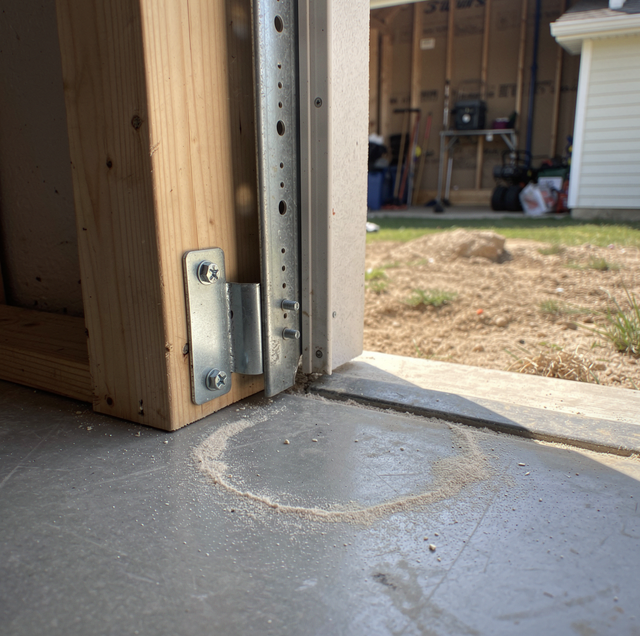
Behind every flag bracket and every hanger holding a garage door track in place sits a handful of lag screws, sometimes backed by a plate washer, sometimes not. What each screw is driven into, more than how many of them there are, decides whether that connection carries the door's side load for years or starts giving up sooner: the weight passed through the rollers, the jolt of every start and stop, and the added pull of a door that has drifted out of balance over time.
The Flag Bracket and the Jamb Behind It
Most vertical tracks carry two or three flag brackets between the floor and the top of the opening, distributing the load across the framing rather than concentrating it at a single point. Each bracket's job is narrow but specific: hold that section of track plumb and tight against the jamb, so the rollers riding inside it stay lined up with the section of door directly above them. A track that has drifted even slightly out of plumb changes how the rollers sit in the throat, which shows up first as extra drag at one point in the door's travel rather than anywhere obvious.
The Horizontal Track's Hangers and the Ceiling Above
Where the vertical track bends into the horizontal run, the load shifts from the jamb to the ceiling joists, carried by a series of hangers or a strip of perforated angle spaced along the horizontal track's length. Their job is to maintain that run level and keep the rollers riding true through the transition, where most of the sideways force is generated as the door approaches full open. A hanger that has started to sag changes that geometry the same way a loose flag bracket does lower down, just further back in the door's travel.
What the Lag Screws Bite Into
What a lag screw grips behind the trim matters more than how many turns it took to drive it. A lag driven into solid framing, a full stud or a doubled jamb member, bites deep into wood fiber and resists being pulled straight out along its shank. One driven into a shim used to plumb the framing during construction, into the edge of a stud where it splits the fiber instead of gripping it, or into drywall with nothing solid behind it, never has that same hold to begin with. Under years of normal cyclic load, that difference in the original bite is usually what separates a bracket that is still tight from one that has started to work loose.
Plate Washers and the Load They Spread
A plate washer is a flat, perforated steel plate that sits under a lag screw's head, spreading its clamping force across more wood fiber instead of letting the screw head bear directly on a narrow point. Where a washer is missing, which is common on older installs or ones patched without a full bracket kit, the screw head alone does that work, and repeated flexing can gradually widen or oval the pilot hole beneath it. The bracket can look fully seated and still be gaining a small amount of play with every cycle.
A track that has pulled away from its framing no longer holds the door in a fixed plane. Continuing to run the opener risks a section leaving the track entirely while under full spring tension and roller load.
Why These Fasteners Work Loose Over Years
Several things push in the same direction at once. Every open and close cycle loads the fasteners again, and a garage used as a main entry sees that load many times a day. In a climate with wide summer heat and high humidity, framing lumber dries out and shrinks a little each year, and the wood fiber gripping a lag's threads loses some of its bite along with it; the same humidity promotes corrosion on the screw itself. Expansive clay soil can shift a slab and the door frame built on it just enough to throw a bracket slightly out of the plumb line it was installed to, prying sideways at threads that were never meant to carry that angle. A lag that went into a shim or a stud edge at the original install simply has less margin against all of the above than one that bit into solid framing. And a door that has gone out of balance, most often from spring wear, forces the tracks to carry more of the door's static weight than the system was built to distribute, adding load right at these connections.
The Tells Before a Bracket Lets Go
You might notice a gap opening between the bracket and the jamb where the two used to sit flush, sometimes visible as a sliver of daylight. A bright ring of fresh wood dust on the framing or floor directly below a lag is another one, the pale color standing out against older, weathered wood as the screw works slightly in its hole. The track itself can visibly shift from where it originally sat, a line of old paint or caulk no longer matching its edge. And the door often starts binding or catching at one specific point in its travel, exactly where the loosened bracket no longer holds the track in its original line.
Why an Unsupported Track Is a Stop-Use Condition
The track's whole job is holding the door in a fixed plane as it travels. Once a bracket has let go, that plane is no longer fixed, and a door moving out of it carries hundreds of pounds of section weight and spring tension with it. A technician arriving at a track pulled away from its framing treats the door as out of service until the attachment is corrected, because the failure at that point tends to be sudden rather than gradual. If the door needs to move at all before a technician arrives, that call belongs to a professional standing in front of it, not a guess made from the garage floor. Disconnecting the opener does not make the door any easier or safer to move by hand in this state. The release cord is safe to use only with the door fully closed and the counterbalance intact, and it is never a way to hold a door open.
Where to Look on Both Sides of the Opening
A pulled bracket rarely announces itself the same way twice. What stays constant is where to look: the point where metal meets framing, on both sides of the opening, at the top of each vertical run and along the horizontal track overhead. Catching movement there before a section leaves the track is the difference between a fastener repair and a much longer visit.
Frequently Asked Questions
Yes, in effect, even though each flag bracket only anchors its own vertical track. Both tracks and the horizontal run between them are dimensioned to keep the whole door square in one shared plane, so a shift on one side changes the geometry the opposite track has to work within, which is why a technician checks both sides even when only one shows a visible gap.
It changes which fastener is behind the trim in the first place. An opening framed in wood typically uses lag screws into a stud or a doubled jamb member, while an opening built against masonry uses a different anchor, such as a sleeve or masonry screw, and those tend to fail from corrosion in the anchor itself rather than from the surrounding material giving way.
It can be, and the timing is the tell. A fastener working loose against wood typically produces a single knock or creak at peak load, right at the start of the lift or during the last few inches of close, rather than a steady sound through the whole cycle.
Only briefly, and the reason is worth knowing. A lag screw that has worked loose has already cut a slightly wider path through the wood fiber than it started with, so driving the same screw back into that same hole can snug up tight and feel solid again while it is still bearing on the same worn fiber that let it go loose the first time. That is why a technician addressing a loose bracket moves the fastener into fresh material, an oversized lag or a longer one seated in an untouched section of framing, or a different anchor point entirely, rather than re-driving the original screw into its own hole.
A roller coming off the track is a problem within the track itself: the wheel has left the throat, while the track remains anchored where it was installed. A bracket pulling away from the framing moves the anchor point instead, so the whole track can be out of its original line even while every roller is still riding inside it correctly.
Sometimes, indirectly. Openers are built to sense abnormal resistance and reverse rather than force a door through it, so as a shifting track adds friction gradually, some openers start reversing partway through a cycle or tripping their force settings before the bracket has fully let go.
Stop cycling the door and have the anchor points checked: off-track repair in Leander puts the flag brackets and hangers back into solid framing, and garage door hardware upgrades swap the worn lags and missing plate washers instead of re-driving them into the same tired holes. Squared Away Garage Door Service serves Cedar Park and Central Texas. Call (512) 456-3781.
