
Single vs. Double Garage Door: More Than a Width Choice
Before anyone talks panel profiles or window inserts, a good installer brings a tape measure to the opening and writes down four numbers: clear width between the jambs, headroom above, side room outside each jamb, and backroom into the garage. Those four decide more about the single-versus-double question than any showroom photo does, because they set what the counterbalance, the track, and the framing will be asked to do.
Two eight-foot doors and one sixteen-foot door close the same hole in the same wall. They do not close it the same way. A wide door is not a narrow door stretched; it is a different load problem, and every piece of that problem lands somewhere in the hardware.
Width Changes the Load Math, Not Just the Look
Three quantities change when a two-car opening gets one leaf instead of two, and they do not change at the same rate.
Weight scales with area: double the width in the same gauge, insulation, and glazing, and you roughly double the weight, with cable rating, drum capacity, and roller load following.
Panel bending scales with the square of the span: a section is a beam supported near each end by the vertical tracks, so doubling the distance between those supports puts roughly four times the bending mid-panel under the same pressure.
Framing sag scales harder still: for a beam carrying the same load per foot, bending grows with the square of the clear span and deflection with the span to the fourth power. Double the clear span and the same beam sags on the order of sixteen times as much.
Hold a yardstick at both ends and press the middle, then try a six-inch ruler. Same steel, same push; span does the rest.
How Counterbalance Sizing Actually Scales
Torsion springs do not care how wide a door is. They care what it weighs and what radius the cable drum wraps at, because the torque the shaft must produce is the door's weight times that drum radius. Widen the door, roughly double the weight, and the required torque roughly doubles with it.
That torque comes from wire diameter, inside diameter, and length traded against each other, with wire size dominating. Width does not change the method. It changes the number those three have to hit.
Wide doors usually run a pair of springs on one shaft: The two sit on either side of the center bearing plate and split the torque, keeping wire size and working stress lower in each than one spring doing the whole job, and leaving partial counterbalance if one lets go.
Narrow doors hit the opposite constraint: shaft length. A high-cycle spring reaches its rating by working at lower stress, which usually means a longer spring for the same torque. On an eight-foot door, there is only so much tube between the center bracket and the end bearing plate, so a cycle upgrade that drops onto a wide door can run out of room on a narrow one.
Extension springs stay common on singles and rare on doubles: A pair mounted above the horizontal tracks pulls independently on each side, so any difference between them shows up as the door lifting crooked. A torsion shaft drives both drums off one rigid tube, which is what a heavy, wide door needs.
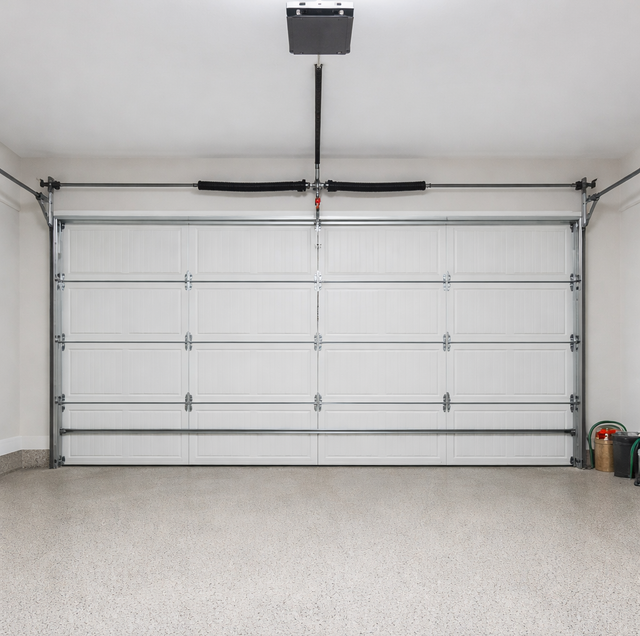
That tube matters more as the opening widens. On a sixteen-foot door, torque travels roughly eight feet each way, and an undersized tube winds up enough that the far drum turns a beat after the near one. The door comes up out of level, the low side's cable slackens, and that is how a wrap jumps its groove. Heavy doors get a heavier shaft, matched drum wraps, and a center bearing plate lagged into solid framing, since that plate takes the full reaction of both springs.
Struts, Track, and the Hardware Holding the Span
A section holds its shape through a thin steel skin, its end stiles, and whatever horizontal reinforcement is bolted across the back. That reinforcement is a strut: a U-shaped or hat-shaped steel channel running end to end behind the panel, turning a section that would flex in the middle into one that carries its load out to the tracks. Manufacturers publish strut requirements by width and rating, and the count climbs faster than width does. A narrow single often needs a strut only on the top section, where the opener arm attaches; a wide double commonly gets struts on several sections, sometimes doubled on the top one.
Other hardware scales with weight rather than span: more hinges per seam, thicker end hinges at the stiles, rollers with longer stems and more balls in the race, and vertical track fastened to solid jamb lumber rather than a stack of shims. The piece most often shortchanged is the back hang, where perforated angle iron braced at an angle holds a heavy door's horizontal track steady and flat plumber's strap lets it flex until the door binds at the curve where vertical becomes horizontal.
The Header Above and the Post Between
The framing above the opening is a beam, and its span is whatever the door arrangement leaves it. One wide door means that beam carries roof and wall load across the whole clear width with nothing under the middle. Two doors normally put a post between them, so each half spans less, and that post needs a continuous path through the slab to a footing that can take it.
Where a wide header already spans the full opening, two doors can go under it with a non-bearing divider between them. The divider carries no roof load, but it still has to be built solid, because it takes the jamb brackets, the vertical track, and possibly a spring anchor for the doors on either side.
Header depth is where this circles back to the counterbalance. A beam gains stiffness far faster from depth than from width, so a longer clear span normally means a deeper beam, and that depth comes out of the headroom above the opening, which is the space the torsion shaft, the springs, and the curve of the horizontal track have to occupy. Standard-lift torsion generally wants around a foot of it. Movement below counts too: soil that swells and shrinks with moisture lifts a slab unevenly, and the same tilt reads as a bigger corner-to-corner difference across a wide opening.
Wind Pressure on One Wide Span vs. Two Narrow Ones
Wind acts on a door as pressure spread over its surface, so the total force on a two-car opening is about the same whether one door covers it or two. What changes is how far that force travels before reaching something anchored to the building. On a wide door, each section spans the full opening between two tracks, and mid-panel sits farthest from any support. Two narrow doors halve that span and put four vertical tracks and four bracket columns under the same total load, which is why a wide door needs its strut package to behave the way two narrow doors behave without one. Suction works the same arithmetic outward: a wide door presents more area behind fewer rollers and brackets, so the pull-out load per connection runs higher.
What the Opener Has to Do in Each Setup
Horsepower does not fix a door whose springs no longer match its weight. The counterbalance carries it, and a bigger motor only hides the mismatch until the top section, the opener gear, or the spring gives up.
Width changes the motor's job in three ways: more mass to start and stop, more rollers generating friction, and a much longer top section pulled from one point in the middle by the operator arm. That last one is why manufacturers call for a strut across the top section and an operator reinforcement bracket through-bolted to it, since a single-point pull on a wide, thin panel dishes that section over thousands of cycles. Manufacturers commonly recommend stepping up from the entry motor class for insulated doubles and wood doors. One spec does not change with width, and it catches people out: rail length is set by door height, so an eight-foot-tall door needs a rail extension kit whether it is nine feet wide or eighteen.
Wall-mounted jackshaft openers sidestep that problem by driving the torsion shaft directly, which suits heavy wide doors and clears the ceiling, though they need a torsion system rather than extension springs, side room for the motor, and a door in balance. Two doors instead mean two motors, two logic boards, and two photo-eye pairs: more to maintain, and the root of the redundancy argument, since a surge that kills one board leaves the other bay working.
Single vs. Double, Side by Side
| Factor | Two Single Doors | One Double Door |
|---|---|---|
| Weight and torque | Half the weight per door; each spring set sized on its measured weight | Double the weight on one shaft, and torque with it |
| Spring and shaft | Often one spring per door; extension springs workable; short torque path | Matched pair at the center bearing plate; long torque path, heavier tube |
| Panel span and struts | Half the span; often a strut only on the top section | Full-width span; several struts, often doubled on top |
| Track and jamb connections | Four vertical tracks and four bracket columns share the load | Two of each carry the same total load |
| Framing above | Shorter spans, but usually a post and footing between them | One clear span, no center support; a deeper beam eats headroom |
| Opener arrangement | Two motors and boards; a failure closes one bay | One motor and control point; a failure closes the whole opening |
Matching the Configuration to the Opening You Have
Two doors in a two-car opening are not two half-width doors. Each needs side room at both jambs for vertical track and brackets, commonly three and a half to four inches per side, plus the divider between them, so each finished opening lands well under half the original width. That is mirror clearance on a full-size truck, and the room beside a car where a child seat gets loaded.
The framing already standing decides much of the rest. What is left is how each setup fails, and two doors split that risk rarely evenly, since one bay becomes the daily entrance and burns through its spring's rated cycles while the other sits. Knowing which trade-off you would rather live with, measured against an opening someone has put a tape on, is what turns this from a styling preference into a decision.
Frequently Asked Questions
No. Each door is its own stack of sections on its own track and spring system, so each needs its own operator. The control side can be shared: most manufacturers' multi-button remotes and wireless keypads pair to both receivers, so one visor remote and one keypad run both doors from separate buttons. Each door still needs its own pair of photo-eyes, mounted low on its own track, generally within about six inches of the floor, since sensors only report to the opener they are wired to.
Travel time is set by door height and the operator's speed, not by width, so a sixteen-foot door and an eight-foot door of the same height reach full open in about the same number of seconds. What changes is the start and the stop. A heavier door takes longer to come up to speed and carries more momentum into the stop, which is why a soft-start and soft-stop profile earns more on a wide door than a narrow one. Two doors offer something the clock does not show: one bay can be cycled without opening the whole wall to the weather, which matters on a garage that doubles as a workshop.
Usually deeper, and where headroom is tight, framers reach for options carrying the same load in less depth, such as laminated veneer lumber or a steel beam kept flush in the framing. Whoever sizes it also has to know what bears above: a girder truss landing over the opening drops a concentrated point load, a different beam than one carrying a spread load. The ends count as much as the middle, since a longer span drives more load into the jack studs at each jamb, and that is the same lumber the vertical track gets lagged to.
No. Backroom is a function of door height and hardware, not width. A standard-lift setup wants roughly the door's height plus about eighteen inches of clear ceiling run for the horizontal track, plus more for a trolley opener's rail and motor head. Two eight-foot-wide doors and one sixteen-foot door of the same panel height need the same depth into the garage. Width spends side room at the jambs; it does not touch the run overhead.
Yes, though not by simply halving it. Cycles split unevenly in most homes, and the idle door is not automatically the healthier one. Sitting still lets lubricant dry out of roller bearings and hinge pins, lets the bottom seal take a permanent set against the slab, and gives humidity time to work on cable ends and spring coils without the wiping action regular travel provides. The door opened twice a week wants the same annual look at rollers, hinges, cables, and balance as the one opened ten times a day.
Two doors, in principle, since each panel spans less and stays flatter against its own weatherstrip. What two doors add is a third vertical joint: the divider between them carries stop molding and weatherstrip on both faces, and that is the joint most often left half-finished. One wide door has only two vertical edges to seal but one continuous bottom edge, so a slab that is high in the middle or low at one corner turns into a visible gap far more often. The total run of concrete under the opening barely changes between the two, which is why the condition of that slab decides more here than the door count does.
Have the opening measured before you commit to a configuration — a technician can check headroom, side room, and backroom, look at the existing header and spring setup, and lay out what each arrangement would actually involve. Squared Away Garage Door Service serves Cedar Park and Central Texas. Call (512) 456-3781.
