
Garage Door Hit by a Car: What to Check Before the Opener Runs
Quick Answer: Check the door before the opener runs. Work outward from the point of contact: the struck section and its stiles, the hinges at that joint, the rollers and track behind it, then the bottom bracket, cable, and top fixture.
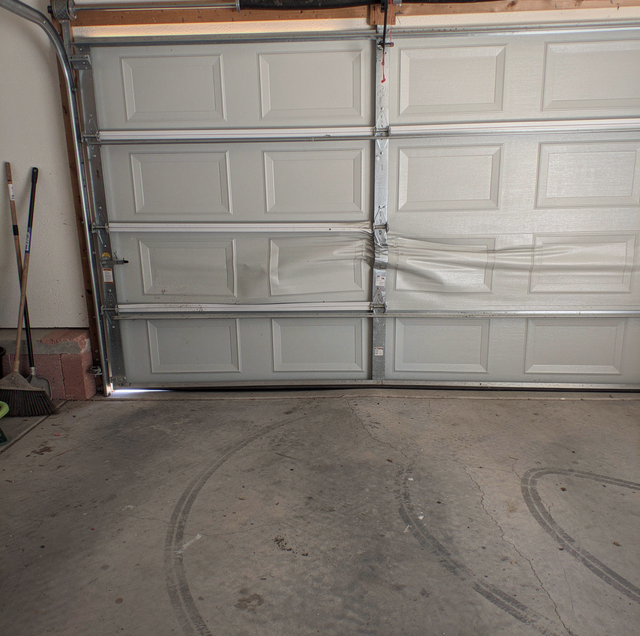
The door is still standing there with a mark on it. Somewhere across its face is a crease, a dished panel, or a scuff where paint transferred off a bumper, and that spot is the entry point for everything worth checking. Force does not stay where it lands. It travels outward from the point of contact into hardware built to carry steady lifting tension rather than a sudden sideways shove, and most of what it did is elsewhere, not in the dent. Working outward from that mark, in the order the force traveled, shows what the door actually absorbed before the opener gets a chance to add to it.
The Struck Section: Skin, Core, and Stile
Start at the panel itself. The visible skin is thin steel, and a dent or a crease there is the least of what to look for. Run a hand along the section and feel for a seam where the skin has separated from the insulation core behind it, a change from a flat surface to a slight give under light pressure. On an insulated door, that core is bonded to two steel skins, front and back, and an impact hard enough can shear that bond without tearing either skin. Behind the foam sit the stiles, the vertical reinforcement channels that close each end of the section and stiffen its middle, and that give the hinges something solid to bolt into. A stile that has buckled or bowed will show up as a section that no longer sits flush against its neighbors, even where the skin itself looks fine.
The Hinges at the Damaged Joints
Every hinge at the edges of the struck section is now suspect. Look at each leaf for a tear where it meets the panel, and at the screw holes for ovaling, where a round hole has stretched into an oval under the sudden load. A leaf can look undamaged while the sheet metal around its screws has already given way, which is why the joint is worth checking by feel as much as by sight. A bent hinge knuckle, the barrel the pin passes through, will bind the two leaves against each other and keep the panel from folding the way it is built to at that joint.
The Rollers and the Track Behind the Impact
On the side of the door where the hit landed, look at the roller stems for a bend. A stem that is no longer straight holds its wheel at an angle inside the track, and the roller will bind or grind on the next cycle instead of rolling freely. Follow that same side up into the vertical track section directly behind the impact. A track's throat, the channel the roller wheel rides inside, is what keeps a roller riding true. An impact can pinch that throat narrower or spread it wider at one spot, and either change means a roller that fit correctly an hour ago no longer does. A section of track that bows toward the opening, or bellies away from the wall, indicates that its throat has changed.
The Bottom Section's End Stile and Weather Seal Retainer
A bumper sits low, so on many of these impacts, the first thing it touches is not the middle of a panel at all. It is the bottom edge of the bottom section. Along that edge runs the seal retainer, an aluminum or vinyl channel fastened the full width of the door, holding the T-shaped bead of the weather seal in its slot. A retainer that has been crimped, folded over, or pulled off its fasteners at one end is the plainest evidence that the hit landed low, and the seal itself usually shows it first: it hangs out of its channel, sits twisted, or has been pushed clear of the slot along the damaged stretch.
The retainer matters past the draft it stops. It is screwed or riveted into the bottom section's own steel, so a retainer driven upward has transferred that load to the section's bottom flange and to the end stiles, the vertical channels closing each end of that section. Those end stiles are what the bottom brackets bolt into. A crushed or dimpled end stile means the bracket carrying the cable is no longer resting against sound steel, regardless of how the bracket itself looks from the front. Sight along the bottom edge of the closed door from one side: an even line of daylight along the floor, or a gap that opens up over a two-foot stretch and closes again, says that edge is no longer straight.
The Bottom Bracket and Lift Cable
A hit low on the door puts the bottom bracket in the load path. That bracket anchors the lift cable to the bottom corner of the section, and it stays under tension any time the door is closed, holding the counterbalance system in check. A bracket that is bent or torn loose from the corner can let the cable go slack and crowd out of its groove on the drum on the next cycle, or fray where it now bends at a sharper angle than it was built for. Look at the cable itself for strands that have separated from the main line, a sign it is stressed even while it is still holding.
The Top Section and the Operator Arm
A hit hard enough to push the whole door assembly inward, rather than just deform one section, sends that force all the way to the top. Check the top section's fixture bracket, where the opener's arm bolts to the door, for a bracket pulled loose or a bolt hole torn through the panel. The arm itself can bend along its length under that kind of shove, and a bent arm changes the angle at which it pulls the door, putting uneven load on the top section every time the opener runs afterward. If the impact reached this far, the flag bracket at the top of each vertical track, and the hangers carrying the horizontal track back to the joists, are worth a look as well, since they are next in line.
Why the Opener Should Be the Last Thing You Touch
Running the opener before this walk-through is what turns a one-panel repair into a track, cable, and opener repair. A bent roller stem forced through a narrowed throat can jump the track entirely. An opener judges only how hard it is working, so a door dragging a bent part can finish most of a cycle before the motor registers anything wrong. A torn hinge under power can let a section fold past the point the door was ever designed to bend. A bottom bracket that is already compromised, put back under cable tension by a closing cycle, is exactly the kind of load that leaves a cable slack enough to crowd out of its groove. The release cord is safe to use only with the door fully closed and the counterbalance intact, and it is never a way to hold a door open. If the vehicle needs the door clear before anyone can inspect it properly, that is a call for a technician, not a reason to run the opener and see what happens.
When the Door Was Rammed on Purpose
The same inspection order applies when the door was struck deliberately, in an attempted break-in, rather than by accident. A deliberate hit tends to land closer to the middle of the door than a parking mishap does, which puts more of the load onto the center stile and onto both vertical tracks at once rather than one. Check both sides of the door, not only the side nearest wherever the vehicle made contact. Treat anything electrical- the opener's console, the wall button, the sensor wiring- as suspect too if the attempt reached that far, since a forced door can pull wiring loose from its mounts even when the wire itself looks fine. Do not run the opener here either, for the same reason: a section already weakened by a deliberate hit is even less able to absorb the load of a powered cycle.
Frequently Asked Questions
Yes. A slow nudge, like a bumper edging past a door that was not fully open, can carry enough sideways force to knock a roller out of its track or shift a hinge screw without leaving a mark on the steel skin at all, so a door that looks untouched can still need the same check described above.
The load path shifts overhead, and the place it concentrates is the radius, the curved piece of track where the vertical run turns and becomes the horizontal run. An open door is already resting its weight there, so a shove adds a sideways load to a bend that is only carrying a downward one by design. The perforated angle used for hangers can also twist out of square without a single fastener pulling, so check that the horizontal track still runs level back from the radius rather than sloping or leaning.
If the vehicle is still touching the door or wedged against a section, moving it away, without operating the garage door, comes first. A door under continuing pressure from a parked vehicle concentrates stress at whatever point remains in contact, which changes what an inspection would find compared to checking it once the two are no longer touching.
The sensors themselves can withstand an impact and keep working, while their mounting bracket, usually near the bottom of the track on each side, gets slightly knocked out of alignment by the same hit. A bracket that has shifted even a small amount is a separate item from the structural checks above and easy to overlook because the sensor's light is still on.
Sometimes indirectly. Force from a hard hit can travel up the vertical track into the end bearing plate above it, the plate that carries one end of the torsion shaft, even when the springs and the shaft are nowhere near the point of contact. If the door felt heavier or lighter than usual the last time anyone moved it by hand, that is worth mentioning, since it is a sign the shock reached that far.
It can, through the shaft connecting the two sides at the top of the door. If the drum on the far side gets torqued by an uneven load carried across the torsion shaft, the untouched side's cable and drum can end up under slightly different tension than before, even though nothing on that side was hit directly. Checking only the struck side leaves that tension difference in place.
Schedule a full post-impact inspection — a technician checks the panel, hinges, rollers, track, and opener together so nothing downstream gets missed. Squared Away Garage Door Service brings that walk-through to driveways around Cedar Park and Central Texas, straightens what can be saved through off-track and bent-track repair in Pflugerville, and turns to a custom-built replacement door only when the impact took the structure with it. Call (512) 456-3781.
