
Storefront Roll-Up Door Won’t Close: 5 Calm First Steps
Quick Answer: Most after-hours failures on a rolling steel door trace back to a short list of causes, and you can rule out three of them from the floor in under ten minutes without touching anything under tension. What follows is that order, plus the point at which the correct move stops being troubleshooting and becomes securing the opening some other way.
A roll-up door that quits at closing time is a security problem first and a repair problem second, and those two jobs pull in opposite directions. The reflex is to keep hitting the down button until something gives. That reflex is what turns a twenty-minute service call into a curtain that has to be pulled out of its guides and rehung.
How a Rolling Storefront Door Is Supposed to Close
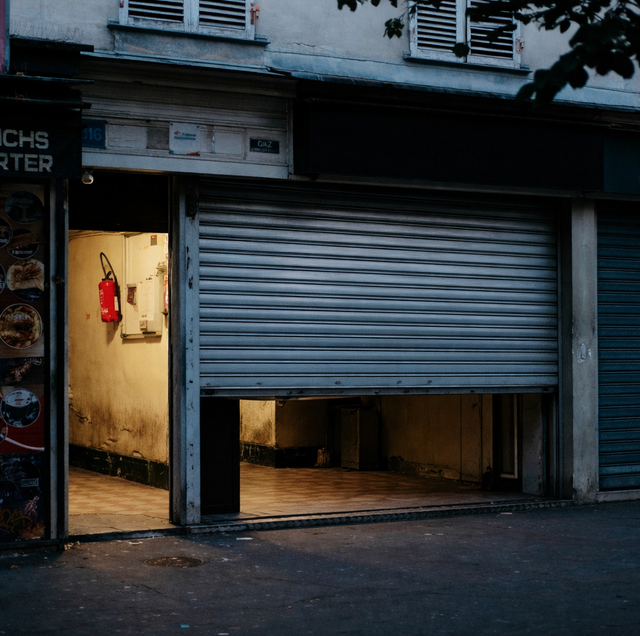
A rolling service door is a curtain of interlocking steel slats that coils around a barrel above the opening. Inside that barrel sits the counterbalance, usually a torsion spring assembly wound to offset the curtain's weight. Hence, the operator only has to overcome friction and inertia rather than lift the full load by brute force. The curtain rides in a steel guide on each jamb. At the bottom is the bottom bar, which carries the floor seal and, on most commercial installations, the sensing edge.
The operator is typically a jackshaft or gear-head unit mounted beside the barrel, connected by drive chain or direct coupling, with a brake that holds the curtain in position whenever the motor stops. Commands come from a wall station (open, stop, close), sometimes joined by a key switch, timer, or card reader. Limit switches tell the operator where fully open and fully closed are.
Closing is the direction that can hurt someone, so it is the direction with the most ways to be stopped. Entrapment protection devices, meaning the photo eyes across the opening and the sensing edge on the bottom bar, have authority to halt or reverse a close command on their own. Control faults, a loss of power, a jam in the guides, and a failure inside the barrel all present identically from where you are standing: the door does not move.
Fire-rated coiling doors are a separate category: If the opening is protected by a fire door rather than a standard service door, do not attempt to reseat or raise it. A fire door that has dropped or partially dropped has to be reset and re-certified by a qualified technician, and most service companies keep a record of that reset for the building's fire-inspection file.
Step 1: Clear the Opening and Stop Pressing the Button
Move people, carts, and vehicles out from under the curtain, then press stop. If the door is partway down and holding, leave it there rather than cycling it up and down to "see if it catches."
Each additional attempt drives the motor against whatever is holding the door. A stalled motor draws far more current than a running one, and on a single-phase operator that punishes the capacitor and trips the thermal overload built into the motor. Once that overload opens, the operator stays dead until it cools, which means even after you find and fix the real fault, the door may sit unresponsive for a while longer. Two attempts is plenty. Ten is how you add a second failure on top of the first.
Step 2: Check the Guides and the Floor Line
Take a flashlight and walk the full opening, both jambs and the threshold. The most common after-hours cause is something entirely ordinary sitting where the curtain needs to travel.
Look for a pallet corner or strapping band pushed into the guide, a chunk of shrink wrap or cardboard packed at the base, a padlock or slide bolt someone engaged earlier and forgot, a bent bottom bar, or a slat that has walked out of the guide and shows as a bulge or a gap along the edge of the curtain. Check the floor line itself for a floor mat, a dock plate, gravel, or a pooled spill that has frozen or dried into a ridge.
Guides collect grit year-round from both directions: airborne dust in dry stretches, and mud, grit, or debris tracked in during wet stretches. Either way, the result is the same: a curtain that drags in the guide and an operator that reads that drag as an obstruction.
Step 3: Check the Devices With Veto Power Over a Close Command
Photo eyes mount low on each jamb and shine a beam across the opening. Most have an indicator LED: one steady light on the sending unit, one on the receiver that changes state when the beam breaks. Look at both. A lens filmed with dust, a beam interrupted by a rack, a trash barrel, a parked pallet jack, or a display that got shifted during the day will all hold the door open. So will a photo eye knocked out of alignment by a cart. Wipe the lenses with a dry cloth and clear the beam path.
The sensing edge on the bottom bar is either pneumatic (a hollow rubber edge, an air hose, and a pressure switch) or electric. A crushed sensing edge, or a cut or pinched air hose, behaves like a doorbell button held down: the operator keeps receiving the same obstruction message and refuses to move in the closing direction.
Many commercial operators monitor their own safety devices and will disable powered closing entirely if a self-check fails, rather than closing without protection. That state usually shows up as a fault code or a blinking pattern at the operator or the wall station. Photograph it before you call. It is one of the more useful things you can hand a technician.
Step 4: Rule Power In or Out
If the wall station is dark and the door makes no sound at all, work backward through the supply.
The disconnect near the operator: Many commercial installations have a fused disconnect or a lockout switch within sight of the unit. Cleaning crews, contractors, and well-meaning staff throw these more often than you would guess.
The breaker: Look at the panel and find the breaker serving the door, checking whether one sits out of line with its neighbors. Resetting a tripped breaker once is reasonable. If it trips again, stop and call a licensed electrician. Do not remove the panel cover, and do not touch wiring under any circumstances.
A plug-in operator: Lighter-duty units may be corded. Check the receptacle and any GFCI upstream of it.
The building's schedule: If the property runs an energy management system or a time clock, the circuit feeding that operator may be switching off on an after-hours program.
Step 5: Listen to What the Motor Is Telling You
Sound narrows the diagnosis faster than anything else you can do from the floor.
Silence with no indicator lights: A power or control problem. Go back to step four rather than continuing to press.
A hum with no movement: The motor is energized, but the shaft is not turning. That points to a brake that is not releasing, a failed capacitor on a single-phase unit, a curtain jammed hard in the guides, or, on three-phase power, the loss of one leg of the supply. A motor humming under a stalled load heats quickly, so give it one short attempt and then leave it alone.
The motor runs freely, but the curtain does not move: The drive chain has come off or broken, a sprocket key has sheared, or the operator is still in hand-chain mode with the clutch disengaged from an earlier manual operation.
Grinding, clattering, or scraping while it moves: The curtain is fighting the guides, a barrel bearing is failing, or slats are out of alignment. This is the sound where continuing to run the door does real, expensive damage. Stop.
Know the Point Where Troubleshooting Ends
Some findings mean the flashlight goes back in the drawer, and the phone comes out.
Any sign that the counterbalance has failed is a hard stop: a curtain that suddenly feels far heavier than usual, a loud bang heard earlier in the day, a curtain hanging crooked or sagging in the guides. The springs inside that barrel and any cables on the assembly are under stored tension and are professional-only components. Nobody without the right tools and training should be near them, on a commercial door or a residential one.
Also stop if the curtain has partly come out of a guide, if the operator housing would have to be opened, or if the fix would involve anything inside an energized panel. And resist the temptation to force the door down with the hand chain past clear resistance. Forcing is what converts a simple part replacement into curtain removal, rehanging, and sometimes new slats.
Ways to Secure the Storefront While You Wait
The goal for tonight is a defensible building, not a repaired door. If the curtain came down partway and holds, that partial closure combined with an interior grille or a locked inner door may already be adequate. If the opening is wide open, a sheet of plywood anchored to the jambs, an interior scissor gate, or a vehicle parked tight against the opening all buy time; keep fire egress in mind and never block the exit path of anyone still inside.
Move portable, high-value inventory out of sightlines, call the police non-emergency line to report an open storefront, and notify your monitoring company that the perimeter is compromised. Photograph the door and the opening before and after placing any barrier, then check your own insurance policy and lease for what securing the premises requires and who has to be notified.
What to Tell the Technician When You Call
The more the dispatcher knows, the better the odds the right part is already on the truck. Have ready: the door type (rolling steel service door, rolling grille, or fire-rated coiling door), the manufacturer name off the guide, bottom bar, or operator label, whether the building is single-phase or three-phase, exactly what the door did (silence, hum, moved and reversed, moved and ground), where the curtain is sitting now, and any fault code displayed. Say plainly whether the opening has to be secured tonight or whether a temporary barrier is holding; a two-visit approach, secure now and repair when parts arrive, is common on commercial doors.
Keeping This From Becoming a Recurring After-Hours Call
Doors that fail at closing time usually gave warning during business hours. A hesitation at the same point in travel, a new noise, a bottom bar that no longer seals evenly across the floor: those are service calls you get to schedule instead of emergencies you have to absorb.
Keep the guides and the floor line clean. Most manufacturers call for a light, non-tacky lubricant on guides or none at all, since heavy grease collects grit and increases drag rather than reducing it. Base the service interval on how hard the door works, because a door cycled dozens of times a day wears on a different clock than one opened twice. Manufacturers generally ask owners to test the entrapment protection on a routine schedule and keep a record of those tests, rather than discovering a failed device the night it matters. If forklifts or delivery carts pass through the opening, guard posts at the jambs pay for themselves the first time someone clips one.
The gap between a bad night and a bad week is usually the first ten minutes: whether they go into looking, listening, and securing, or into pressing a button that was never going to work.
Frequently Asked Questions
That is a different fault pattern than a door that will not move at all, and where it reverses matters. Reversal at the same point every cycle points to a mechanical binding spot: a bent slat, a dented guide, or a curtain that has shifted on the barrel. Reversal at random points, or at a different height each attempt, points instead to an intermittent electrical fault in the sensing edge circuit, a loose coil cord on the bottom bar, or a photo eye drifting in and out of alignment. Note which pattern you see and tell the technician; it changes what gets tested first.
Usually less than owners expect. Standby battery units exist for some commercial operators, but they are generally sized for a limited number of cycles, enough to get the door closed and locked rather than to run a normal day. They are also more common on lighter-duty units than on large three-phase gear-head operators, which draw more than a small backup can supply. A building generator only helps if that specific door circuit was wired to the emergency panel, which is a design decision made at installation, so check the panel schedule now rather than finding out at nine at night.
Sometimes, and only if it moves freely. Manual operation requires the operator's clutch or floor-level disconnect to be engaged first, and most units have a direction arrow cast or stickered near the chain wheel. If the chain turns with no resistance and the curtain does not move, or if the curtain wants to run down on its own, stop immediately and call for service. Both symptoms indicate a counterbalance or brake failure, and the curtain is heavy enough to injure someone badly on the way down. Never chain the door partway and walk away from it.
Often not without an override. A roll-up door with a contact on the bottom bar reads as an open zone, and most panels refuse to arm with an open perimeter point. Bypassing that zone lets the system arm, but it also removes that opening from monitoring entirely, so interior motion detection becomes your only coverage there. Call your monitoring center rather than bypassing it silently: they can place the account in a noted state, confirm what is still covered, and log the condition, which is far more useful than an unexplained bypass showing up in the history.
It can, on both counts. Many operator manufacturers exclude damage from continued operation against a known obstruction or fault, and running the motor repeatedly against a stalled curtain is exactly that. Separately, most commercial operators log fault events, including repeated close attempts, in an internal counter or service menu, so a technician arriving after several forced tries can often see that history on the board even without being told. Two clean attempts and a call preserve both the warranty and the diagnostic trail.
Parts availability, mostly. Photo eyes, sensing edges, capacitors, limit switch assemblies, and drive chain are common truck-stock items, and a door failing on one of those can often be back in service on the first visit. Curtain slats, matched counterbalance springs, and barrel components are sized to the specific opening and generally have to be ordered or fabricated, which is where multi-day timelines come from. If the fault turns out to be on the supply side of the disconnect, a licensed electrician is a separate trade and a separate scheduling step, so ask early whether that handoff is likely.
Call for emergency commercial door service — get the door closed, the opening secured, and the fault diagnosed right. Squared Away Garage Door Service dispatches from Cedar Park across Central Texas, whether the storefront needs after-hours emergency door service in Leander or an overnight emergency callout in Austin, and stays until the curtain is down and locked. Call (512) 456-3781.
