
Roll-Up Storefront Security Doors: 3 Curtain Types Compared
A storefront security door has to do two jobs that pull in opposite directions. Closed, it needs to be hard to get through. Closed, it also has to keep earning its place on the storefront: showing merchandise to someone walking past at nine at night, letting air move through a space still warm from the day's cooking, and giving a passing patrol a way to tell whether anything inside is wrong.
No single curtain does all of that equally well. The three families sold for storefront openings are solid slat, perforated or vision slat, and grille. Choosing well depends less on which is "most secure" in the abstract than on what sits behind the glass, who can see the storefront after closing, and what the space needs while it is shut.
The Parts All Three Share
A rolling storefront door is the same machine in every version, with a different curtain hung on it: a spring-loaded barrel above the opening, guides bolted to the jambs, and a bottom bar carrying the lock hardware. Those springs stay under high tension even when the door is open, so winding, adjusting, or replacing them, along with anything involving the shaft, brackets, cables, or the operator's power wiring, is professional-only work.
What changes between the three curtain types is everything downstream of that shared frame: weight, spring size, how the curtain fails, and what the storefront looks like when it is down.
Solid Slat Curtains: Full Barrier, No Sightline
A solid curtain is built from interlocking formed steel slats, each rolled to a flat or curved profile and hinged to its neighbors across the full width. Endlocks fasten to the slat ends to keep the curtain centered in the guides, and on openings exposed to wind load, endlocks with windlock tabs hook into the guide so the curtain cannot be pulled out under pressure.
This is the strongest of the three as a physical barrier and the only one that gives complete privacy, and that privacy cuts both ways. A solid curtain hides the interior from a patrol car or a neighboring owner who might otherwise notice a light on or a case tipped over, and anyone who does get past it works unobserved. Solid curtains also give vandals a large flat canvas, which is why a sacrificial anti-graffiti clear coat is a common add-on. It is also the heaviest curtain, meaning the largest counterbalance and the most load on brackets and fasteners.
Perforated and Vision Slats: Light and Air Through a Slat Curtain
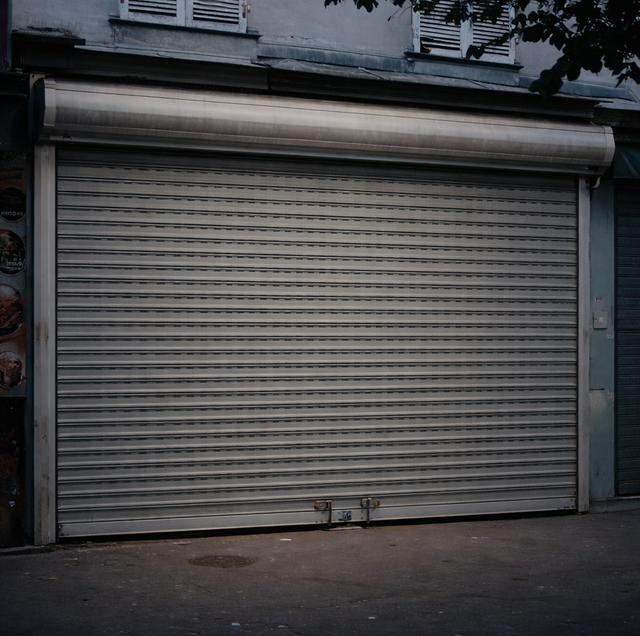
Perforated slats are ordinary slats with holes punched into the face. The curtain still interlocks and rides in the same guides, so the geometry of the door does not change. Light passes through, a partial view of the interior is possible from close up, and air moves across the opening.
Some manufacturers also offer vision slats, where openings in the slat face are filled with clear polycarbonate. Those give the sightline without the airflow, which suits a business that wants a readable display but no open path for dust, insects, or sidewalk spray.
Perforation removes material from the slat face, so the workable combinations of pattern, slat gauge, and opening width are narrower than for solid curtains; confirm what is offered for your width and height. A common answer for retail is a mixed curtain: solid slats across the lower portion, perforated or vision slats above. The solid section covers the height where someone could work at the curtain, and the upper section carries the light.
Grille Curtains: Sightlines and Airflow, Lighter Barrier
A rolling grille is not slats at all. Its curtain is built from horizontal rods, usually aluminum or steel, joined by short vertical links. The links set the spacing between rods, and their arrangement sets how open the curtain reads: a straight pattern aligns the links in columns, a brick pattern staggers them. Manufacturers publish open-area figures for each pattern and link length, and those are the honest way to compare grilles rather than guessing from a photo.
Grilles win on both things a solid curtain gives up. The interior stays visible, so a lit display keeps selling after hours and anything wrong inside shows. Air moves freely, so the space is not sealed. The curtain is also the lightest of the three, which usually means a smaller counterbalance and often a compact tube motor inside the barrel.
The tradeoff is that a rod-and-link curtain is a lesser barrier than a sheet of interlocked steel. It can be cut or spread with the right tools, and it stops nothing thrown at it. What it does do is make an attempt slow and visible, which for many storefronts is the deterrent that matters most. On an exterior wall holding conditioned air, that open construction cuts the other way, since a grille does nothing to slow the air exchange discussed below; it suits an interior opening or a covered storefront more comfortably than a directly exterior one in a space that runs heating or cooling hard.
Reading Your Own Risk Profile
The comparison only becomes useful when aimed at a specific storefront, so start with what is true about yours.
What is inside after closing: Compact, high-resale goods that move easily on a secondary market pull toward solid or mostly solid curtains, for the barrier and the concealment together. A service business whose assets are client records and fixed equipment has a different exposure, and a grille that keeps an empty-looking space visible often fits better.
Who can see the storefront at night: A shop on a lit street with foot traffic and regular patrols gets real value from a see-through curtain, because visibility turns an attempt into a report. A unit at the back of a lot with no sightline gets little from transparency, and concealment plus a stronger barrier makes more sense.
What happens if the glass goes: An exterior-mounted curtain shields the glazing, so a thrown object hits steel. An interior grille leaves the glazing to be broken, which means boarding, a dark display, and a glazing order even when nothing is taken.
What the space needs while it is closed: A kitchen, a repair bay, or a stall inside a larger building may need air exchange through the opening, and that requirement can override display preferences entirely.
Who else has a say: Landlords, tenant-improvement criteria, and some municipalities set their own rules for storefront security doors, and a few restrict fully solid roll-downs on street-facing openings. Treat this as practical clarification rather than a legal reading: check the tenant criteria you were given, and ask your local building department what applies before ordering a curtain.
Ventilation Is a Building Question, Not a Preference
A solid curtain changes how air behaves behind it in both directions through the year. In warm stretches, heat that would bleed out of the opening stays put, and a space that ran equipment all day stays warm into the night. In cold stretches, the same sealed curtain traps moisture from mopped floors and cooking, and that moisture settles on the coldest surfaces available, usually the curtain and guides.
A perforated or grille curtain is not a ventilation system. It simply stops being a plug, so whatever air movement the building already has keeps working through the opening. For a food business with exhaust that needs makeup air, or a bay where engines run, that is not a comfort question. Ask a mechanical contractor before assuming a solid curtain is fine.
Where the Door Mounts Changes What It Protects
A face-mounted exterior door hangs outside the wall above the opening, protects the glazing, and takes the weather and the vandalism itself. An interior mount keeps the curtain clean and out of the storefront's daytime appearance, but leaves the glass exposed. Either way, the door needs headroom above the opening for the barrel and hood, plus side room on both jambs for the guides, and on a retrofit that space often settles the question before preference does.
How These Doors Get Defeated
The guides: Prying the curtain out of its guides is the classic approach. Guide depth, anchor strength, and anchor spacing up the jamb all matter, as do the endlocks or windlocks that keep the curtain captured.
The bottom bar: A corner of the bottom bar is the easiest place to get a tool under. Slide bolts into the floor or jambs, or a cylinder lock through the bar, to hold the curtain down. A motorized door resists lifting through its gearing, but the positive lock does the security work. Where a lock is added to a motorized door, a lock interlock switch cuts operator power while the bolt is thrown, so the motor cannot tear against a locked curtain.
Everything beside the door: A well-specified curtain over an opening flanked by ordinary glazing and a hollow-core rear service door has moved the problem rather than solved it.
Keeping the Door Working
Grit in the guides is the most common reason a curtain starts binding, running crooked, or sounding rough. Keeping guides clear and lubricated to the manufacturer's instructions, and having the reversing edge and any photo-eyes checked on a schedule, covers most of what an owner can do. Counterbalance, brackets, fasteners, and operator adjustment belong on a professional service visit.
To decide between the three, stand outside your storefront at closing time and write down what you would want a stranger to see and what you would rather they could not. Then have a technician measure headroom and side room. Those two lists usually narrow the choice before anyone opens a product catalog.
Frequently Asked Questions
With a wide-spaced pattern, yes, which is why display setback belongs in the specification. Merchandise staged against the curtain line is reachable with a hook or a length of wire, so displays should sit back and locked cases should stay out of arm's range. Where a display has to stay near the glass, a grille curtain ordered with a solid lower section closes the gap.
For a security door, that is the case that matters: the storefront can't be secured for the night until the curtain comes down. Compact tube motors inside the barrel typically carry a manual override crank or a release cable for exactly this, letting the curtain be lowered by hand without power. Gear-driven operators use a hand chain instead, kept in a chain keeper beside the opening so it cannot swing into traffic when not in use. Either way, the curtain should never be forced if it will not move under normal manual effort; that usually means something mechanical is binding, not just a dead outlet.
They add a step. Perforations collect road film, dust, and insect debris, and a pressure washer aimed straight at them drives that material into the curtain's roll instead of off it. A soft brush and a low-pressure rinse from an angle work better. Finish matters too: a powder-coated curtain cleans more easily than a mill-galvanized one, and deep scratches through galvanizing are where corrosion starts at the slat edges.
The sound comes from rods and links entering and leaving the guides, so a grille produces a series of small metallic impacts where a slat curtain produces a steadier rumble. Replaceable nylon or plastic wear strips inside the guides absorb much of it, and lubricant helps, though a heavy grease attracts grit and eventually makes the noise worse. A dry-film product is usually better unless the manufacturer specifies otherwise.
Both are worth a call. Some commercial property policies list protective devices the business agreed to keep in service, so adding or removing a security door is something your agent should hear about rather than discover after a claim. Shielding the glazing also moves where detection belongs: a glass-break sensor tuned to the storefront window matters less behind a solid curtain, and interior motion coverage or a contact on the bottom bar often makes more sense.
Usually not. A technician can remove the bottom bar and slide damaged slats out of the curtain, and grille curtains are repaired by replacing the affected rods and links. Bent guides are sometimes straightened, more often replaced, and endlocks are routine wear items. The judgment call comes when a vehicle strike bends the barrel or shifts the brackets, because that changes how the curtain tracks and how the counterbalance is loaded.
Schedule a storefront security door assessment — get a curtain that matches your risk, your display, and your airflow needs. Squared Away Garage Door Service works out of Cedar Park and travels the Central Texas corridor for commercial door installation and replacement in Austin as readily as for Round Rock storefront door replacement, sizing the guides, barrel, and counterbalance to the curtain you choose. Call (512) 456-3781.
