
Storm-Damaged Garage Door: Why It Still Moves but Isn’t Safe
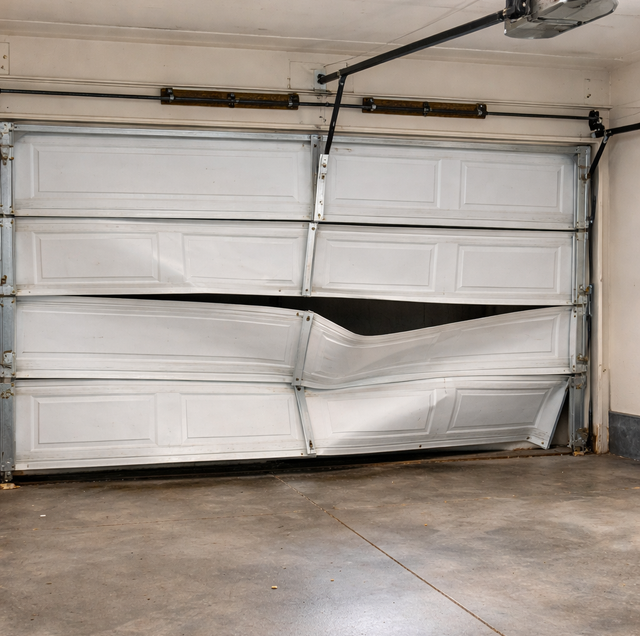
A garage door that opens the morning after a storm has passed exactly one test: the opener produced enough force to move it. That is a much lower bar than undamaged. The parts that carry its weight, hold it square, and keep it from coming down uncontrolled can all be bent, cracked, or pulled loose while the door still travels its full path and sounds about the way it always did.
High wind loads the door as one large panel and racks the framing around it. Hail strikes the exterior skin thousands of times in a few minutes and works the joints behind it. Neither has to break the door to change it, and the failure that matters usually shows up later, on an ordinary cycle.
Why a Damaged Door Still Travels
The opener is not what lifts the door. A counterbalance system does that: torsion springs wound on a shaft above the opening, or extension springs stretched along the horizontal tracks, offsetting nearly all of the door's weight so the operator only has to start it, steer it, and stop it. Because the opener holds a reserve of force it never normally needs, new resistance gets absorbed instead of announced. The motor pulls harder, the springs work at a different point in their range, and rollers scrape sideways instead of rolling clean.
Two clocks run after a storm. One is immediate: something broke, and you know it. The other is a fatigue clock, where a part gets loaded in a direction it was never meant to carry, every cycle, until it reaches its limit. Storm damage usually starts the second clock, and the door keeps working the whole time it runs.
Bent Track and Rollers That Ride Out of True
Each roller has a stem seated in a hinge and a wheel that rides inside the throat of the track. The track is a guide, not a structural member, and it works only when the wheel sits centered in it. A vertical track pushed off the jamb, a radius with a flare in it, or a horizontal run with a slight kink will still pass the roller through. The wheel just climbs one wall of the throat and pushes back through the stem into the hinge.
The door still travels because the wheel keeps turning even when it is riding the wrong wall of the track, the same way a shopping cart with one crooked wheel still moves, just not cleanly. The load that should have stayed centered goes sideways instead, into roller stems, into hinge leaves that begin to dish, and into the screws holding those hinges to the section skin.
What to look for: Scrape marks concentrated at one height rather than spread along the run, roller stems that wobble in the hinge, elongated screw holes at hinge leaves, and a fresh gap between a jamb bracket and the jamb. Left alone, the sequence ends with a roller leaving the track partway through travel: the door racks, one lift cable goes slack while the other keeps tension, and the load turns asymmetric on a system with no tolerance for it.
Cracked Sections That Hold Their Shape Until They Don't
A section gets its stiffness from its shape and framing, not from the flat face you see: on a steel door, the roll-formed profile plus the end and center stiles, and on an insulated door, the bond between the two skins and the foam core, which behaves as a structural sandwich.
A crack at a stile-to-skin joint, or a split radiating from a hinge fastener, does not drop the section. Closed, the stack is supported at the bottom and held at the perimeter by the tracks, so the shape holds. Then it cycles. Every pass through the radius bends that section, the crack opens and closes with it, and it grows in the one direction the geometry keeps pushing.
Insulated doors hide a defect you cannot see from outside: an impact can break the skin-to-core bond across an area while the face still reads as a shallow dent, so the section keeps its looks and loses stiffness. On wood, a split at a rail gets worked by moisture cycling in both directions, since damp weather swells the fibers and dry heat shrinks them again. Give the top section its own look too, since the opener arm bracket concentrates the operator's push and pull into a small area of one section, and fasteners tearing out of the skin there is a common late failure.
Bowed Sections and What Wind Load Leaves Behind
Wind does not only push. It loads the windward face with positive pressure and pulls the leeward face with suction, and a garage door is a large flat panel spanning jamb to jamb with nothing supporting the middle. Struts, the horizontal reinforcing bars across the back of a section, hold that deflection within limits, and doors built for higher wind exposure add vertical posts, heavier stiles, or more struts. A load past what the assembly was built for can leave a section permanently bowed.
Closed, the bow is nearly invisible: the tracks hold the sides, the bottom seal compresses against the floor, and a curve through the middle reads as a shadow. Open the door, and the consequence appears. The bowed section no longer presents a straight edge to the rollers, so it twists slightly every time it rounds the curve, and when it is the top section, that twist carries into the operator rail and trolley. If the door came with wind-load reinforcement, treat that hardware as an engineered package rather than generic parts; manufacturers rate reinforced doors to a design pressure that assumes the specified posts, struts, and anchoring.
The Counterbalance System Is the Part You Cannot Judge by Eye
Springs, cables, drums, and bottom brackets hold the door's entire weight, moving or parked. This is professional-only territory, and storm damage is exactly what makes amateur contact with it dangerous.
A binding door raises the effective load the counterbalance sees every cycle. Lift cables run from the bottom brackets up to grooved drums on the torsion shaft, and when a door racks, a cable can climb out of its groove, wrap over itself, or jump the drum. A cable struck by debris can carry broken strands hidden inside the lay of the wire while looking intact from a few feet away. Bottom brackets sit under cable tension whenever the door is down, which is why they carry warning labels. None of it is a homeowner adjustment; it needs a technician with the tools to control that tension.
Inspect the Full Travel Path, Not Just the Ends
Most people judge a door by pressing the button and watching it reach the top and the bottom. The information you need is in the middle, and the look that finds it stays entirely hands-off.
- Sight down each vertical track: From the floor, with the door closed, it should run parallel to the jamb the whole way, with an even gap.
- Check every bracket: Jamb brackets, the flag bracket atop each vertical track, and the overhead hangers. Bare metal, a lag screw standing proud, or bent angle means something moved.
- Walk both sides of the door: Look at each hinge leaf and roller stem individually rather than scanning the door as a whole.
- Look at the framing, not only the hardware: A jamb or header that shifted takes the track with it, so the track looks bent when the wood is the problem.
- Read the perimeter with the door closed: Daylight along the top or one side, or a bottom seal touching unevenly, means the door is sitting out of square.
- Watch one full cycle from a safe distance inside: Note the height at which any noise, hesitation, or shudder happens. Where it happens in the travel is the diagnostic, not the noise itself.
One thing to skip: do not pull the emergency release and lift a suspect door by hand. A balance test is a technician's step on a storm-damaged door, because it drops the door's full weight onto a counterbalance nobody has confirmed yet.
Signs That Should Take the Door Out of Service Now
A few findings are not wait-and-see. Stop cycling the door if a scrape or pop lands at the same point in travel every time, if the bottom edge runs out of level, if either lift cable goes slack, if the opener strains or reverses partway, if a section visibly flexes rounding the curve, or if any bracket shows fresh gaps and loose fasteners. Each one means load is going somewhere it was not designed to go.
Cosmetic Damage Versus Damage That Changes the Door
One shortcut deserves a direct warning here: when a storm-damaged door starts binding, turning up the opener's force adjustment so it powers through the tight spot is the wrong response. Down-force settings tie directly to how the opener recognizes an obstruction and reverses, and raising force to overcome resistance eats the margin that safety behavior depends on. A door that trips its opener is giving you a reading; the resistance was the information.
Dents in the flat face of a skin, scuffed paint, and chipped finish are cosmetic when the stiffeners and joints behind them are intact. The distinction is not size. Damage crossing an end stile, a center stile, a hinge location, a strut, a track, a bracket, or a bottom fixture is not cosmetic even when small, because those parts carry load. A coin-sized dent mid-panel and a coin-sized crease at a stile are two different repairs.
A single section replacement handled within a week or two of a storm is a normal repair. The same damage left to cycle for a season, working its way through hinges, rollers, and a track that was never quite reset, is how that same repair turns into a whole-door replacement.
Frequently Asked Questions
Sound maps to location. A scrape or squeal landing at one height points to a deformation the roller meets at that spot. A rhythmic click repeating four or five times per cycle usually tracks hinges and rollers passing through the radius, once per section. A gritty rumble across the whole travel is more often roller bearings, since steel rollers with exposed ball races pick up storm grit far faster than nylon rollers with sealed bearings.
With the operator disconnected, the door is raised partway and released. A balanced door stays roughly where it is put. Drifting down means the springs are no longer offsetting the weight, from lost spring tension or a cable that shifted on its drum; rising on its own means the counterbalance is overpowering the door. Technicians also measure lift effort with a scale near the bottom bracket line, which catches partial spring loss the drift test alone can miss.
Yes, and it changes what gets inspected. A torsion system sits on a shaft above the opening with a cable drum at each end, so racking shows as uneven cable wrap on the drums and a shaft no longer level in its bearing plates. An extension system runs springs along the horizontal tracks with pulleys and a longer cable path, so racking pulls a pulley out of line and can let a spring rub the track. Extension-spring doors also carry a containment cable threaded through each spring to catch it if it breaks, and a missing or corroded one is its own finding.
They can, for reasons unrelated to depth. The exterior coating is the door's corrosion protection, so an impact that crazes or chips that finish creates a start point for rust in the substrate that can take months to surface, well after the storm that caused it is forgotten. A hail strike on a galvanized steel skin is usually self-limiting once the coating is intact again, but the same strike on a painted aluminum or wood composite skin can lift the finish enough to let moisture track underneath, which is why the follow-up check matters more than the panel material might suggest.
Yes. A nearby lightning strike or a utility surge can damage the logic board while the motor and gearbox keep working. The symptoms read as electronic rather than mechanical: travel limits that no longer hold their setting, force calibration that drifts, a wall control responding intermittently, remotes that stop pairing, or safety sensors reporting an obstruction with nothing in the beam. Low-voltage sensor wiring and its splices are common casualties too. Work inside the power head or at the circuit belongs to a technician.
The checklist changes with the door type. A rolling steel door can have bowed curtain slats, damaged endlocks or windlocks, and a curtain pulled partway out of its guides, none of which stop it operating. Sectional commercial doors add heavier struts and often a jackshaft operator with an electric brake, which can hold a door in place well enough to mask a counterbalance problem. Because a storm can hit an entire building's worth of openings at once, a post-storm commercial check usually means walking every door on the property rather than testing the one that seems worst.
Book a post-storm garage door inspection — catch the damage hiding behind a door that still opens. Squared Away Garage Door Service covers Cedar Park and the wider Central Texas storm belt, pairing a full structural safety inspection with emergency garage door repair in Brushy Creek when a cracked section or bowed panel means the door should come out of service today. Call (512) 456-3781.
