
Garage Door Manual Lock Broke? What's Actually Pinning It Shut
Quick Answer: A broken manual lock is rarely the handle itself. The failure is usually somewhere between the handle and the track: a broken cam, a seized bar, or a slot that no longer matches where the bar wants to sit.
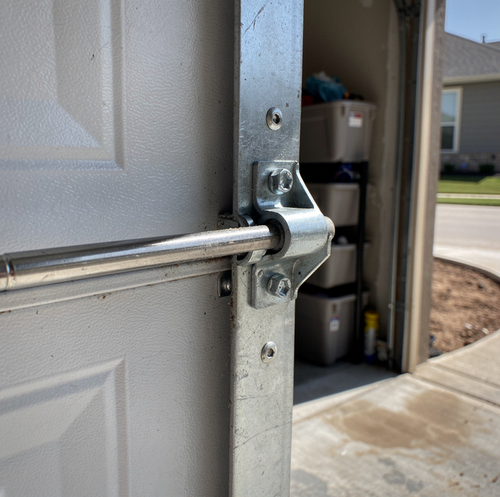
Turn the T-handle on the outside of a sectional garage door, and a short chain of parts moves that most homeowners never actually see. The handle turns a cast cam or a bent-wire lever inside a housing bolted to the bottom section. That lever pushes a spring-loaded bar sideways through a run of steel guides fixed along the panel. The bar's tip crosses the gap where the door meets the vertical track and drops into a slot punched through the track wall. When every part of that path lines up, the door is locked to the track itself, independent of the opener. When it doesn't, the T-handle can turn while nothing downstream of it actually moves, and the reason is rarely the handle.
The Handle Has to Turn the Cam, Not Just Itself
The T-handle's shaft passes through a cast or stamped housing screwed to the face of the bottom section. Turning it rotates a small cam, or in some hardware, pushes a bent-wire lever that transfers the motion to the bar. That link is usually a slot-and-pin fit or a friction fit, not one solid part. When it separates, the handle keeps turning through its full range with no resistance and no click, because it's spinning against nothing. The bar stays exactly where it was, thrown or withdrawn, regardless of which way the handle turns.
The Bar Has to Slide the Full Length of Its Guides
Past the housing, the bar rides in a series of steel guide brackets screwed to the bottom section, spaced along the width of the door to keep it running straight instead of wandering off-line. For the lock to work, the bar has to travel that entire distance freely, guide to guide, all the way to the track. Rust from humidity can seize a guide shut on the bar. So can a guide bent inward, whether from an old impact or from the door frame itself shifting on expansive clay soil, pinching the channel just enough that the bar rides tight instead of sliding.
The Bar's Tip Has to Meet the Slot Squarely
At the far end, the bar's tip has to reach a slot punched through the wall of the vertical track and meet it straight on. The slot is cut to a specific height and angle, matched to the bar it was built for. If the track has racked out of true, or the bar itself has taken a slight bend along its length, the tip can arrive close to the slot without actually reaching it, striking the face of the track instead of passing through it. From the outside, the handle turns, and the bar visibly moves; the lock still doesn't engage.
The Door Has to Sit in the One Position Where It All Lines Up
Even with a working handle, a free-sliding bar, and a true slot, the lock functions only with the door in one specific position: fully closed, the bottom section seated on the floor. The slot and the bar's line of travel are matched to that position and no other. A door that stops an inch or two short of full travel, because an opener's limit setting has drifted or because something is blocking it, puts the slot slightly out of reach of the bar's resting line. The handle, the bar, and the track can all be functioning correctly, and the lock still won't throw, simply because the door isn't where the hardware expects it to be.
Why This Hardware Predates the Opener
The mechanical slide lock exists independent of anything electric. It was standard equipment on sectional doors well before openers were common, and on a garage with no opener at all, such as a detached workshop or a storage building, it's still the entire security story for that opening: a padlock or combination lock through the handle's eye, the bar thrown into the track, done.
On an attached garage with an opener installed, that same hardware is usually left unthrown on purpose, because the opener's own drive arm holds the door against its track through the carriage connection. The sliding bar covered here is the mechanical, unpowered version, bolted straight to the door itself.
When One Link Breaks Instead of Sliding Back
A few distinct failures produce the same complaint: the lock won't open, won't close, or the handle spins loose. A T-handle's cast body can crack at its base, where the shaft meets the housing, letting the handle rotate free of the cam it used to turn; the bar stays exactly where it was left, usually thrown. A bar can bend or seize inside its guides, most often from rust after long exposure to humidity, so it won't travel back out of the slot even though the handle and cam are both moving correctly. Or the slot itself can deform, from an old impact or corrosion at the cut edge, gripping a bar that would otherwise withdraw cleanly. Each is a failure at a different point along the same chain, and which one it is changes what a technician actually has to open up.
The One Configuration That Turns a Stuck Bar Into an Opener Problem
The bar throwing while the opener is still connected to the door is the configuration that matters most. If the bar is seated in the track and the opener then receives a command to open, the drive tries to lift a door that's pinned at the bottom section, working against the guides, the bracket, and the track slot instead of against the counterbalance it's built for. The opener reads that resistance and reverses once it passes what its force settings allow, which protects the door but is no argument for finding out where that limit sits.
If the bar's position isn't confirmed, running the opener risks pulling the bottom section against a bar still seated in the track, straining the guides, the bracket, and the panel before anything trips.
The manual release cord hanging from the carriage disengages the opener from the door, and it's a different tool for a different problem. The release cord is safe to use only with the door fully closed and the counterbalance intact, and it is never a way to hold a door open. It doesn't touch the lock bar at all.
What Determines How Secure the Door Actually Is
None of these failures make the garage door easier to force from outside; the panel, the tracks, and the opener's own resistance to lifting are unchanged. What changes is whether the extra layer this hardware was supposed to add is actually there. A stuck bar can hold a door that appears normal from the driveway but isn't actually secured by anything beyond the opener itself, or it can hold a door that won't open by any normal means until something along its lock chain is corrected. Which one you're dealing with looks the same from the T-handle: a knob that won't turn the way it used to, for reasons the handle alone can't tell you.
Frequently Asked Questions
It does. The housing, the guide brackets, and the bar are all bolted through that one section and leave with it. Whether the same hardware goes back on depends on the bolt pattern lining up, the bar still being straight, and the slot in the track not moving, so the reinstalled hardware has to match the slot cut for the old panel. A section replacement is often when a lock that has been broken for years finally gets dealt with, since the hardware is off the door anyway.
Yes, and it's arguably the quieter failure. Rust inside the guides can hold the bar retracted just as easily as it can hold it thrown, so the handle turns and appears to work, but the bar never actually reaches the slot. The door still opens and closes normally; it simply isn't locked to the track the way it looks like it should be.
Mechanically, usually yes. Many sectional doors use a keyed cam lock in place of a T-handle, but it drives the identical spring-loaded bar through the same guides into the same track slot. A broken cylinder produces the same stuck-bar symptoms described above; only the part turned by hand is different.
Indirectly. A steel track expands slightly as it heats through the day, which can shift a slot's position by a small but real amount. A bar that seats cleanly in the cooler morning can bind against that same slot by mid-afternoon, without anything having actually broken.
Yes, if it's the guide closest to the housing. A bracket bent inward right at that first stretch of travel can stop the bar within an inch of the housing, so from outside it looks and feels like the handle is turning loose, even though the cam and the handle are both working correctly.
The handle housing on the face of the bottom section, before anything at the track end. It is the one joint that can be confirmed or ruled out in seconds, and the answer decides where the rest of the search goes: a cam still driving the bar sends it outward along the guides in the order the bar travels, while a cam turning free of the bar ends the search there. Working from the track end instead means unfastening guides that were never the problem.
Schedule a hardware inspection — a technician can trace the lock chain from handle to track and get the door securely operating again. Squared Away Garage Door Service replaces the failed link with lock bars, T-handles, and guide hardware across Cedar Park and Central Texas, Georgetown included, so one visit ends with a door that locks the way it was built to. Call (512) 456-3781.
