

Steel-Backed vs. Vinyl-Backed Insulation: Why the Backing Matters
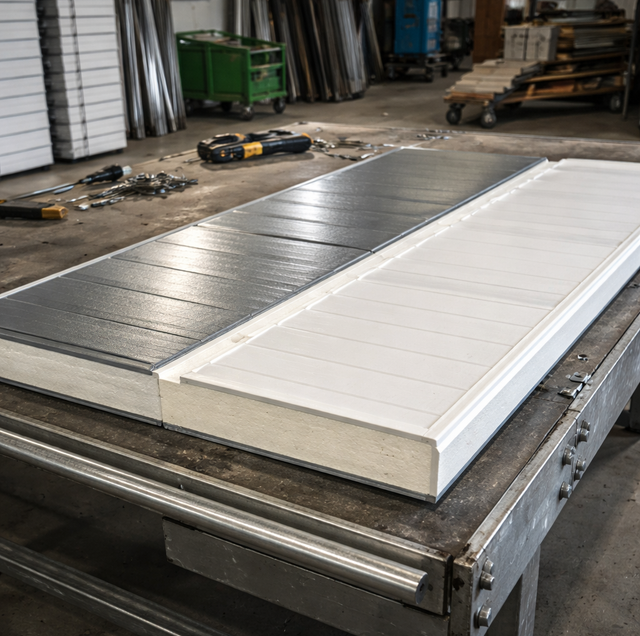
"Insulated is insulated" is the assumption that rides along into most new-door decisions, and it's wrong in a way that matters. Two doors can carry the same R-value sticker and still perform nothing alike five years later, because the number on that sticker only describes the foam in the middle of the panel. It says nothing about what's holding that foam in place on the side facing your garage. That's the part the spec sheet treats as an afterthought and the part that actually determines how the door behaves once it's hanging on your tracks.
Every insulated garage door panel is built the same basic way: an outer steel skin facing the weather, a foam core in the middle, and a backing material on the interior face that closes the sandwich. The backing isn't decorative. It's a structural layer, and manufacturers build it two different ways: a second sheet of steel, or a lighter vinyl or thermoplastic laminate. Those two choices produce two different doors wearing the same "insulated" label.
What the Backing Layer Actually Does
The foam core, whether it's polyurethane or expanded polystyrene, resists heat flow because trapped gas bubbles inside rigid foam conduct heat poorly. That's the whole mechanism behind an R-value. But foam by itself is soft, crumbly at the edges, and has nothing to bond to a finished interior surface. It needs something on the inside face to hold its shape, protect it from being crushed or gouged, and seal it off from the garage air on the other side.
That interior layer does three jobs at once: it caps the foam so it can't be dented or worn away from the inside, it adds stiffness to a panel that would otherwise flex under wind load or an off-track jolt, and it forms a continuous air and vapor barrier between the garage and the foam core. How well a door does all three depends entirely on what that layer is made of.
Steel-Backed Construction: The Full Three-Layer Sandwich
A steel-backed panel uses a second sheet of steel, usually a lighter gauge than the outer skin, bonded to the inside face of the foam core. Most steel-backed doors use polyurethane foam injected as a liquid between the two steel skins and expanded in place, so it bonds directly to both surfaces rather than sitting loose between them. The result is a true structural sandwich: steel, foam, steel, acting as one rigid unit rather than three separate layers stacked together.
That bonded three-layer build is what gives a steel-backed door its stiffness. Because both skins are metal and both are chemically bonded to the foam, the panel resists twisting and flexing far better than a single-skin door, and the interior face can take a knock, a bike handlebar, a stored ladder leaned against it, without denting or cracking. Air and vapor sealing: a continuous steel interior face has essentially no porosity, so it holds up as a vapor barrier for the life of the door, with nothing to crack, peel, or degrade with age.
Vinyl-Backed Construction: A Lighter Laminate Over the Foam
A vinyl-backed panel swaps that second steel sheet for a thinner vinyl or thermoplastic laminate sheet, typically bonded over a polystyrene foam board rather than foamed-in-place polyurethane. The laminate finishes the interior face, gives it a smooth, paintable look, and seals the foam board, but it isn't a structural skin the way steel is. It's closer to a wrap than a wall.
That construction has a real upside: it's noticeably lighter per section than a steel-steel sandwich, which matters for the hardware discussed below. The trade-off shows up over time rather than on day one. A vinyl or laminate backing can crack, delaminate at the seams, or become brittle with years of UV and heat cycling coming through the panel from outside, and once it splits or punctures, there's no second skin behind it. The foam underneath is directly exposed to whatever hits the panel next.
Steel-Backed vs. Vinyl-Backed, Side by Side
| What You're Comparing | Steel-Backed (Full Sandwich) | Vinyl-Backed (Foam + Laminate) |
|---|---|---|
| Rigidity | High: two bonded steel skins resist flex and twist as one unit | Moderate: foam board and laminate add some stiffness but far less than a second steel skin |
| R-value consistency over time | Stable: sealed, bonded core has no path for the foam to shift or the seal to open | Can drop: cracked or lifted laminate lets outside air reach the foam board over years |
| Weight and opener/spring load | Heavier: adds real load per section, which affects spring wind count and opener sizing | Lighter: less added weight, easier on an existing spring and opener setup |
| Durability of the backing itself | Very durable: steel doesn't crack, peel, or degrade with age | More vulnerable: laminate can crack, delaminate, or puncture, especially with age and impact |
What Happens When the Backing Fails
The two failure modes aren't symmetrical. A steel-backed panel's interior skin can dent under a hard enough impact, but denting steel doesn't expose the foam or open a path for air and moisture. A vinyl-backed panel's failure is different in kind: once the laminate cracks or a puncture goes through it, the foam board underneath is bare, and there's nothing left doing the vapor-barrier job that layer was built for.
It's the same failure logic as a vinyl-covered pool float. The vinyl skin does its job fine right up until something sharp meets it: a stray screw, a dropped tool, a bike pedal swung too close. After that, the seal is gone at that spot and whatever was behind it, air in a float, foam in a door panel, is exposed at exactly the point where the covering failed. On a garage door, that exposed foam edge starts absorbing moisture, gets brittle faster under sun exposure through an open bay, and gives insects a soft material to burrow into.
Heat and UV don't just cause sudden punctures either. The same conduction that makes an uninsulated steel door radiate heat inward also cycles a vinyl-backed panel's laminate through daily expansion and contraction as the interior face warms and cools with the outside temperature. Over years, that repeated flexing is what causes seam lifting and hairline cracking even without a single impact. Cold snaps do a version of the same thing in reverse: a laminate that's gone brittle from UV exposure is more likely to crack under a hard freeze than a fresh one, so the wear compounds from both ends of the temperature range, not just the hot months.
Weight, Springs, and the Opener: Why the Backing Changes the Load
A door's torsion springs and opener are sized to the door's total weight, and the backing material is a real contributor to that number across every section of the door. A steel-backed door with a foamed polyurethane core runs meaningfully heavier per square foot than a vinyl-backed door with a polystyrene board core of similar thickness, because two steel skins weigh more than one steel skin and a laminate sheet.
That weight difference isn't cosmetic. Spring sizing: the torsion spring's wire gauge and wind count are calculated against the door's total weight to balance it correctly; a spring wound for a lighter vinyl-backed door won't lift a heavier steel-backed replacement the same size without adjustment, and running an undersized spring shortens its cycle life and puts extra strain on the opener motor trying to compensate. Swapping backing types on a replacement door, not just upgrading the insulation grade, is a reason to have the spring and opener rechecked rather than assumed to carry over from the old door.
Choosing Between the Two Isn't Just About the Spec Sheet
Neither construction is wrong for every situation. A steel-backed door earns its keep where the interior face takes real abuse, gear leans against it, kids' bikes, a workshop that shares the bay, or where the extra rigidity matters for a wider or taller opening that flexes more under wind load. A vinyl-backed door makes sense where the interior face sees light use and keeping weight off an older spring and opener setup is the priority, as long as the laminate is inspected occasionally for cracking at the seams and around hardware fasteners, since that's where flex concentrates first.
Which one belongs on a given opening comes down to how the interior face gets used and how much weight the existing springs and opener were sized to carry, not to which number on the spec sheet is higher.
Frequently Asked Questions
In most cases, the panel needs replacing. The laminate is bonded across the full face of the foam board rather than applied as a patchable coating, so there's no standard field repair that restores the seal once it's punctured or cracked open; a technician typically swaps the affected panel section rather than trying to patch the backing in place.
Yes. A small magnet held against the interior face gives a fast answer: it holds firmly on a steel-backed panel and won't stick at all on a vinyl or laminate-backed one. It's a useful check before assuming a spring or opener will handle a same-size replacement door without adjustment.
It does. A steel-backed panel's bonded second skin adds mass and damping that reduces the drum-like resonance a single-skin door can produce as it travels through the rollers and tracks, so a steel-backed door typically runs quieter than a vinyl-backed one of similar thickness, independent of the opener type driving it.
It can, more so than on a vinyl-backed panel in some conditions. Because a continuous steel interior skin is essentially non-porous, it can reach the dew point and show surface condensation during a humid stretch the way a cold glass does, whereas a laminate-faced panel is marginally more permeable and less prone to visible beading, though it's giving up sealing performance elsewhere to get there.
No. Laminate thickness and the polystyrene board's density vary by manufacturer and product line, so two doors marketed as vinyl-backed can differ noticeably in how much impact or UV exposure the backing tolerates before it cracks. Checking the manufacturer's stated backing thickness, not just the door's overall R-value, is the only way to compare two vinyl-backed options accurately.
Not special tools, but different sizing. Because the finished panel weighs more, the track rollers, hinges, and bottom brackets need to be rated for that added weight, and on wider doors a heavier steel-backed panel is more likely to call for a dual-spring setup instead of a single torsion spring to keep the lift balanced correctly.
The Question the R-Value Doesn't Answer
A door labeled insulated is only half the story until you know what's backing the foam. Two doors can wear the same label and still age in opposite directions over the years they spend absorbing sun, cold, and the daily use of an attached garage. Steel behind the foam buys rigidity, quiet, and a backing that doesn't degrade on its own timeline. Vinyl behind the foam buys lighter weight and less load on older hardware, with a backing that needs the occasional look for cracking as the years and temperature swings add up. Neither fact shows up on the R-value sticker, which is exactly why it's worth asking before it's already hanging on the tracks.
Weigh the backing choice against what your hardware can already carry — a technician can price insulated garage doors for the opening and quote spring replacement in Hutto if the heavier panel outgrows the springs on the shaft. Squared Away Garage Door Service serves Cedar Park and Central Texas. Call (512) 456-3781.
