

Wood vs. Steel vs. Aluminum Garage Doors: The Real Trade-Offs
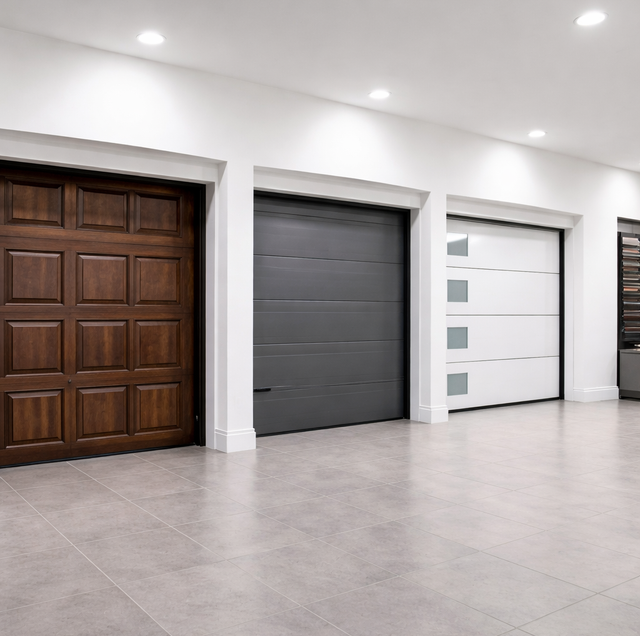
You're standing in a showroom aisle, or scrolling a builder's configurator on your couch, looking at three door samples propped side by side: one with real wood grain running through the panel, one smooth steel skin painted a deep charcoal, one full-view aluminum frame wrapped around glass panes. The salesperson keeps steering the conversation toward finish options and color swatches. That's not actually the decision in front of you. The question that matters is which material's weight, upkeep schedule, and wear pattern over the next fifteen or twenty years fits your door opening, your climate, and how much time you want to spend maintaining a garage door once it's hung.
Each of the three solves the "big moving panel on your house" problem in a real, structurally different way, and none of them is a universal best choice. Style is the part that feels decisive under showroom lighting and almost never is, since all three come in enough colors, panel profiles, and window options that appearance rarely narrows the field on its own. What separates them is structural: how much the door weighs, which sets what springs, track, and opener it needs, how it fails when something hits it, and how it holds up across years of temperature swings and moisture.
Wood: Real Grain, Real Upkeep
A wood garage door is built from actual timber , whether that's a solid-panel door made from cedar or redwood boards, or a hybrid design with a wood veneer over a lighter core. Either way, you're looking at an organic material full of fiber and natural moisture content, not a manufactured skin over a frame. That's exactly why it looks the way it does, and exactly why it behaves the way it does.
Wood's cell structure holds air within the grain itself, which gives it natural insulating value without a foam core doing all the work, the way a steel or aluminum door needs one. That same porous structure is also wood's biggest liability: end grain and panel joints absorb moisture readily if the sealant or paint layer protecting them wears through or gets scratched. Once moisture gets past the finish and into the fiber, the wood swells, and repeated swelling and drying cycles are what eventually warp a panel or start rot at a corner. A sealed, well-finished wood door can go years without an issue; an unsealed edge exposed to repeated wetting can start showing problems within a single season.
Wood is also the heaviest of the three materials by a wide margin for a given door size. That extra mass is part of what gives it a substantial, quiet feel when it operates, but it means the torsion springs, cables, and tracks all have to be sized for that added weight from the start, not retrofitted after the fact.
Steel: Strength-to-Weight, With a Coating to Protect
A steel garage door is a formed metal skin , usually galvanized steel in a gauge chosen for the door's size and duty, sometimes doubled around a polystyrene or polyurethane core for insulation and added stiffness. Galvanizing coats the steel in zinc, and the zinc corrodes sacrificially in place of the steel underneath as long as that coating stays intact. That's the entire mechanism behind steel's rust resistance: it isn't rust-proof, it's rust-protected, and the protection depends on the coating and any paint layer on top of it staying unbroken.
That's also steel's failure point. A scratch, a chip from a stray bike pedal or ladder, or a dent sharp enough to crack the paint exposes bare metal at that one spot. Once the coating is compromised there, moisture reaches the steel directly, and a small rust spot at a scratch or a panel edge can spread if it isn't caught and touched up. Steel resists dents well up to a point, thanks to a strength-to-weight ratio that lets a relatively thin, light panel hold its shape under normal impacts, but a hard enough hit still leaves a permanent crease the metal won't spring back from.
Steel also takes embossing, texture, and paint extremely well, which is why it covers the widest style range of the three: flat panels, deep wood-grain embossing, carriage-house hardware, dozens of colors. For most standard residential openings, steel lands in the middle on weight too, heavier than aluminum but well under a comparable wood door, which is a large part of why it's the most common material installed today.
Aluminum: Won't Rust, Trades Away Some Dent Resistance
Aluminum doesn't rust , and that's not a coating claim the way it is with steel: aluminum forms its own thin oxide layer on exposed metal almost immediately, and that oxide layer is what actually protects the metal underneath from further corrosion. Scratch aluminum and a new oxide layer forms on the fresh surface within hours. There's no sacrificial coating to wear through and no bare-metal rust spot waiting to happen the way there is with steel.
The trade-off is softness. Aluminum is far more ductile than steel, meaning it deforms rather than resisting, roughly the way a soda can dents under a thumb instead of holding its shape the way a steel can would. A stray basketball, a bike handlebar, or a mower thrown carelessly against the bottom panel is more likely to leave a visible dent in aluminum than in steel of comparable thickness, and once it's dented, it stays dented.
What aluminum gives up in dent resistance, it gives back in weight. It's the lightest of the three materials by a clear margin, and less mass moving through the tracks every cycle means less strain on hinges, rollers, and the opener motor lifting the door thousands of times over its working life. That light weight is also why aluminum shows up so often on full-view, glass-panel contemporary doors: an aluminum frame can carry large glass sections without the door becoming too heavy for standard residential hardware to handle.
Wood vs. Steel vs. Aluminum, Side by Side
| Factor | Wood | Steel | Aluminum |
|---|---|---|---|
| Weight (relative) | Heaviest; requires springs, cables, and track sized for the added mass | Moderate; the standard baseline most residential hardware is designed around | Lightest; reduces long-term wear on hinges, rollers, and the opener motor |
| Maintenance need | Refinishing and resealing on a recurring schedule; end grain and joints need attention | Occasional touch-up paint at chips or scratches to protect the zinc coating underneath | Minimal; no coating to maintain, but dents don't pop back out on their own |
| Climate suitability | Vulnerable to swelling, warping, and rot where moisture reaches unsealed grain | Vulnerable to rust only where the protective coating is broken (scratches, dented edges) | Naturally corrosion-resistant; more prone to cosmetic denting than the other two |
| Typical style fit | Carriage-house and custom architectural doors where real grain is the point | The widest range: flat, embossed wood-look, carriage hardware, nearly any color | Full-view and contemporary glass-panel doors, minimalist frame styles |
How Climate Actually Factors Into the Choice
Climate stress on a garage door isn't a single-season event. It's a mechanism that runs year-round in both directions, and it affects each material differently. Humidity is the clearest case: the same ambient moisture that finds bare steel at a scratch also finds unsealed wood at a panel joint, so two very different materials share one exposure that never takes a season off. Aluminum sidesteps it, with no ferrous metal to rust and no porous grain to absorb water.
Heat and UV exposure work on all three in a slower, cumulative way rather than as a summer-only event. Sustained heat and ultraviolet light fade and break down paint and clear-coat finishes on any material, which is why a wood door's sealant and a steel or aluminum door's paint both need periodic attention regardless of which one is installed. Heat also adds to the workload on springs and opener motors indirectly: heavier doors like wood stress that hardware more to begin with, and a spring or motor already working harder has less margin when a hot stretch pushes lubricant viscosity and motor load the wrong way. Cold matters too, stiffening seals, thickening old lubricant, and making any material more brittle at the moment of an impact. None of this favors one material outright; it argues for treating climate as a year-round factor, not a reason to pick a door based on a single season's weather.
Where the Insulation Value Actually Comes From
Insulation is easy to assume is a property of the metal itself. It isn't. A steel or aluminum door's R-value comes almost entirely from whether there's a foam core behind the skin, not from which metal the skin is made of. Manufacturers build that core one of two ways: injected polyurethane foam, sprayed as a liquid between the inner and outer skins and expanding to bond directly to both, or a cut-to-size polystyrene panel simply inserted between them without bonding. The injected foam adds real structural stiffness to the panel along with its insulating value, since it's chemically fused to both metal faces; the inserted panel insulates but doesn't add much rigidity on its own. A steel or aluminum door built without any core, a single skin with nothing behind it, insulates only marginally regardless of which metal it is.
Wood works differently: its insulating value comes from the material itself rather than from anything added behind it, so panel thickness is what carries it. That advantage mostly disappears on a hollow-core or thin-veneer door, where there is far less solid material doing the work and no foam core standing in for it either. In practice, comparing insulation across the three materials means checking whether and how each specific door is built with a core, rather than assuming steel, aluminum, or wood is inherently the better or worse insulator on its own.
Matching the Material to Your Door's Hardware and Structure
Weight is the piece homeowners most often skip past, and it's the one with the most direct effect on how a door performs for the next fifteen years. A door's torsion springs are rated to a specific weight range, calculated in cycles, and the tracks, rollers, and hinges are sized the same way. Swap a lighter steel or aluminum door for a heavier wood one on hardware that wasn't upsized to match, and you're asking springs to lift more than they're rated for on every single cycle, which shortens their working life regardless of how well the wood itself holds up.
The material sets the starting weight and the maintenance pattern. Matched hardware, meaning a correctly sized torsion spring set, reinforced track, and hinges rated for the door's actual weight, is what keeps those advantages from being erased by an undersized spring straining against too much door.
A Simple Way to Decide
Three questions narrow this down faster than comparing finish samples ever will, and the order you ask them in matters as much as the answers.
Start with the opening and the hardware , because that question can rule a material out rather than merely rank it. A heavy wood door going onto a frame, spring set, and track sized for a light steel one is a rebuild, not a swap, and that constraint is settled before anyone's preferences enter into it.
Then decide which kind of failure you would rather live with , a dent that never comes back out or a rust spot that has to be caught early. That single question separates aluminum from steel more cleanly than any brochure spec, and it's the one most people answer instinctively once it's put to them plainly.
Take the look last , even though it feels like the first question in the showroom. It's the only one of the three that more than one material can satisfy, since steel alone spans most architectural styles, which is exactly why appearance so rarely decides anything on its own.
Working through them in that order, rather than starting from which sample looked best under showroom lighting, is what separates a door you're happy with in year one from a door you're still happy with in year twelve.
Frequently Asked Questions
Yes. Manufacturers laminate a textured, wood-toned overlay onto the steel skin during production, which reproduces the look of grain and even distinct species like cedar or mahogany without changing the door's structure underneath. It's still a galvanized steel panel with the same coating-dependent rust protection as any other steel door; the overlay changes the appearance, not the mechanism.
It benefits from one even though corrosion isn't the concern. A mill-finish aluminum door left uncoated can develop a chalky, uneven white oxidation on the surface over years, especially in areas with hard or mineral-heavy water contact, and an anodized or powder-coated finish keeps that oxide layer forming evenly instead of blotching. The finish is mainly cosmetic insurance, not corrosion protection the metal doesn't already have on its own.
Nobody sizes hardware off the material category, which is why the honest answer is a method rather than a number. The figure that matters is the door's measured weight: it is printed on the manufacturer's spec sheet for that model and size, and on a door already hanging, an installer gets it by resting the door on a scale with the springs fully unwound. That weight is what sets the torsion spring's wire diameter, inside diameter, and length, plus the drum size and cable gauge. It also moves more inside a single material than most people expect. Adding a row of glass inserts or a second skin can shift a door enough to change the spring spec, so two steel doors of the same width don't automatically share hardware either.
No, and there's a quick way to tell which kind of door is which without pulling a spec sheet: knock on the inside face. A hollow, tinny sound means a single steel or aluminum skin with no foam core behind it. A dull, solid thud means a foam core is present, whether the door is steel, aluminum, or an insulated wood composite. A solid wood door is the one case the knock test misreads: it thuds like an insulated door because it is dense all the way through, not because a core was added behind a skin.
Reinforced steel, with heavier-gauge panels and horizontal struts added behind the skin, is the material most commonly engineered to meet higher wind-load ratings, since the struts distribute pressure across a rigid metal panel efficiently. Aluminum can be engineered for wind resistance too, but typically needs additional internal bracing since the metal itself flexes more under pressure. Wood doors are rarely built to high wind-load specifications, since the panel construction wasn't designed around that kind of engineered pressure rating.
A general range is every two to four years, shorter on a south- or west-facing door that takes direct sun most of the day, longer for a door in mostly shaded exposure. The interval isn't fixed. It depends on how much direct sun and moisture exposure that specific opening gets, which is also why two wood doors on the same street can need refinishing on noticeably different schedules.
The material you pick is really a maintenance schedule you are agreeing to, and a weight the springs will carry on every cycle for as long as that door is hanging. Get those two matched to your own habits and your own opening, and the finish you chose under showroom lighting stops being the part of the decision that decides anything.
Talk through wood, steel, and aluminum options for your opening — a technician can walk you through which material fits your climate exposure and how much upkeep you actually want to take on. Squared Away Garage Door Service serves Cedar Park and Central Texas. Call (512) 456-3781.
