
Stuck, Jammed, Off Track, or Out of Balance: 4 Faults
Quick Answer: Stuck, jammed, off track, and out of balance are four different failures in four different parts of the machine. Stuck means resistance along the path, jammed means something is blocking the path, off track means a roller has left its channel, and out of balance means the counterbalance no longer matches the door's weight.
The door goes up about eight inches and stops. You press the wall button again, the motor whines, the top section flexes, and nothing else moves. Over the next ten minutes, you will call this stuck, then jammed, then off track, and if you scroll a forum thread while standing there, out of balance. All four come out of the same aggravation. To the technician who shows up, they name four different failures in four different parts of the machine, and only one stores enough energy to injure whoever is diagnosing it.
A Garage Door Does Three Jobs, and Each Word Names a Different One
A sectional door is guided, carried, and moved. Guidance is the track and the rollers: a stem sits in a hinge, and the wheel rides inside a U-shaped steel channel that holds the door to a fixed path.
Carrying is the counterbalance, and it does nearly all the real work. On a torsion system, a spring is wound on a shaft above the header; each end of that shaft carries a cable drum, and a lift cable runs from each drum down to a bottom bracket at the door's lowest corner. The wound spring loads torque into the shaft, the drums turn it into cable tension, and those cables pull up on the two bottom corners with close to the force needed to hold the door's weight. Extension springs do the same job through pulleys along the horizontal tracks.
The moving part is the opener, and it is the smallest contributor. A half- or three-quarter-horsepower residential head nudges a door that is already near weight-neutral; it does not lift a few hundred pounds. The opener is the finger that tips a balance scale, not the arm that hoists the load.
Stuck: Resistance at a Point You Can Find
Stuck means the door meets resistance along its path and quits, by opener or by hand. The behavior repeats. It halts at the same inch every cycle, stays square in the opening, and both sides stop together.
The most overlooked cause is a lock. Many doors carry a slide lock bar on the inside of the vertical track, or a jamb-mounted lock with a keyed handle, and a bar that is thrown or only partly retracted catches in the track slot the moment the door starts up. A door that lifts an inch and stops dead has usually found a lock, not a spring problem. Next is the opener drifting out of calibration: travel limits tell the logic board where the floor and ceiling are, force settings tell it what counts as an obstruction, and either can wander until a normal cycle reads as a stall.
The rest is friction, concentrated in the radius section where vertical track curves into the horizontal run. A roller changes its angle of travel there, so a dry stem, surface rust, or a slight twist shows up at that spot first. A jamb bracket whose lag bolt has backed out of the wood lets the track pinch by a fraction of an inch, which is enough. A stuck door sounds like effort, not like an event.
Jammed: Something Occupying Space That Has to Stay Empty
Jammed means interference. Something sits where the last cycle was clear, and the door has run into it.
The classic mechanical version is a lift cable that jumped its groove on the drum and is now stacking on itself or wedging between the drum and the end bearing plate. Also common: a roller that shed its ball bearings or snapped its stem and turned sideways in the channel, or a track lip bent just enough to catch a roller head at one point. The opener has its own jams: a chain-drive head uses a nylon drive gear meant to be the drivetrain's sacrificial part, so it strips before the motor or board takes damage, leaving the chain moving while the trolley does not.
A jam announces itself with a pop, a scrape, or a metallic clunk at the instant it happens. Worth separating clearly: jammed does not mean off track. A jam can hold a perfectly railed door still, every roller where it belongs.
Off Track: A Roller Has Actually Left the Channel
Off track is literal. One or more roller wheels are no longer inside the U-channel they ride in. Vertical track bolts to the jambs through jamb brackets, meets a curved radius section, and hands off to horizontal track hung from the ceiling on punched angle and hanger straps, with a flag bracket carrying the load at the junction. Nothing in that assembly is built to take sideways force.
The most frequent route is a broken lift cable. When a cable fails, the counterbalance stops carrying that corner, the door racks in the opening as one side drops, and the low-side rollers pull out of the channel in the same second. A vehicle bumper into the bottom panel does it faster, bending the bottom bracket or vertical track outright. It also happens slowly, when a slab or door frame moves with the soil under it and walks the track out of plumb until a roller rides the lip instead of the channel.
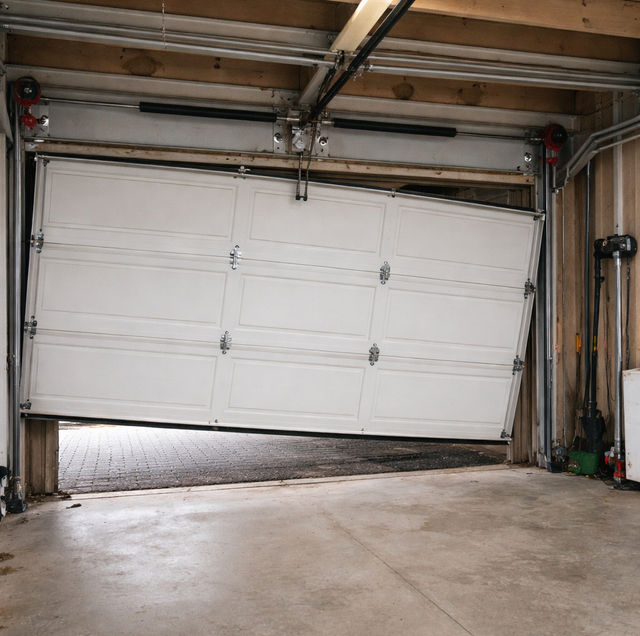
The tells are reliable: a gap between a roller wheel and the track wall, one bottom corner sitting low with the door cocked, a section of track splayed away from the jamb. The part that catches people out is that the counterbalance is usually still loaded even though the door looks finished.
Out of Balance: The Springs No Longer Match the Door
This one differs in kind from the other three. Nothing is obstructing anything. The counterbalance is no longer sized to the weight it carries, and the door often still opens and closes while that is true.
Springs are matched to a door, not to an opener. A torsion spring is specified by wire diameter, inside diameter, and overall length, and those three dimensions set the torque it delivers per turn. Drum size and door height set how many turns it gets wound. Change any of that and the match is gone.
Cycle fatigue is the usual path. A standard-life torsion spring is commonly rated around 10,000 cycles, and as the wire works, it takes a permanent set and returns less torque than it did new. Rust between the coils raises internal friction and shortens that life further, which is why humidity is harder on a counterbalance than heat alone. Installation error is the second path: a spring guessed at rather than calculated from the door's measured weight, or one left in after heavier insulated sections went in. Uneven winding, or drums not set with matched cable tension, hangs the door low on one side even when both springs are healthy.
The symptoms are behavioral rather than visual. The opener strains on every cycle instead of some. The door will not stay where you leave it partway up, and it picks up speed in the last foot before the floor. Safety reverse starts triggering on close, because down-force feedback reads the extra resistance as an obstruction. Over enough cycles, the top section pulls at the operator arm, which is why a reinforcement strut is specified across that panel.
The test that confirms it is the manual disconnect balance test. Close the door fully, pull the emergency release cord to disengage the trolley from the carriage, lift by hand to about waist height, and let go. A balanced door takes light hand pressure to move and stays within a few inches of where you left it. A door that sinks is undersprung; one that climbs on its own is oversprung, which is its own hazard. Do this with the door closed, never partway up, because releasing the trolley on a badly undersprung door hands the full weight to whatever is holding it.
Skip the balance test entirely if you can see a gap in a torsion spring's coil, a frayed or kinked lift cable, a bent track, or a bottom bracket that is not square. Those findings are the diagnosis, and lifting by hand on top of them can drop the door.
Quick Reference: Symptom, Cause, and What to Do
| What You Called It | What Is Failing | The Tell | What to Do |
|---|---|---|---|
| Stuck | Friction, a thrown lock bar, or opener limit settings | Halts at the same inch each cycle, door stays square | Check the lock bar, then stop cycling it |
| Jammed | Cable off the drum, broken roller, stripped drive gear | A pop or clunk as it stops; not repeatable | Clear a loose object only; leave hardware alone |
| Off track | Roller out of the channel, usually behind a snapped cable | Gap at the rail, door cocked, track off the jamb | Stop operating it; keep people from under it |
| Out of balance | Spring torque no longer matched to door weight | Opener strains every cycle; door will not hold position | Balance-test only if springs and cables are intact |
Where the Stored Energy Sits, and What Is Safe to Touch
Two of these faults are safe to inspect closely, and two are not, and the line is where the energy sits, not how broken the door looks. A thrown lock bar, an opener limit that needs resetting, a rake leaning on the track: none of those touch the counterbalance. Springs, cables, drums, and the bottom bracket are a different category. A torsion spring is wound with steel bars seated in the winding cone's holes and holds that load whether the door is open or closed, so a screwdriver substituted for proper bars can slip under torque. An extension spring depends on a safety containment cable through its center; without an intact one, a break sends the spring across the garage. The bottom bracket is where the lift cable terminates, so it stays under full load even with the door sitting on the floor.
One symptom belongs to none of the four. A door that starts down and reverses back up, with the opener light flashing and nothing else out of place, usually has a broken photo-eye beam rather than a mechanical fault, though an opener that reverses with clean, aligned eyes is often reading down-force against a door that has gone out of balance.
Frequently Asked Questions
Hardware failure is more common than impact. A set screw on a cable drum can back off the torsion shaft, letting that drum spin free and dump cable tension on one side without anything breaking outright. A cable that frays where it wraps the bottom bracket pin parts under load with no warning. Either one drops a corner and pulls rollers loose in one cycle.
Re-railing is a load-control job, not a lifting job. A technician clamps locking pliers onto the vertical track under a roller to hold the door's position, then works the section back into the channel while the spring is still trying to move it. And once a track lip is bent, or the flag bracket is out of square, the same roller finds that weak point again within weeks, so the section usually gets replaced rather than tapped back into shape.
It shortens the life of specific parts. On a chain drive, the nylon drive gear takes the abuse first and strips. On a belt drive, the belt stretches, and the trolley wears. Across both, the motor draws more current per cycle and can trip its thermal overload, so the door works in the morning and refuses at the end of a busy day.
Take the opener out of the loop. With the door closed, pull the release and run it up and down by hand through the full travel. Effort that stays roughly even, with the door holding where you leave it, means the counterbalance is doing its job, and that sends the search to the drive instead: a stripped gear, a stretched belt, a worn trolley, or a motor tripping its thermal overload late in a busy day. A door that fights you by hand is a spring question, and no opener part answers it. The overlap is common, since a door left out of balance long enough eventually produces both faults, and the order matters. Springs get corrected first, because resetting force and travel limits against a door that is still heavy only teaches the opener the wrong numbers.
Two checks after any repair. Lay a two-by-four flat on the floor in the door's path and run a close cycle; the bottom section should contact the wood and reverse promptly rather than pressing into it. Then repeat the balance test with the door closed, since that verifies the counterbalance was matched and not just made to move again.
It narrows it a lot, because three of the four arrive gradually and one arrives in an instant. Friction, alignment drift, and lost counterbalance build over weeks, so they almost always come with a history somebody can recall once asked: a catch that got louder, an opener working harder, a door that stopped holding position. A cable, a roller, or a drive gear part breaks in a single cycle with no warning at all. A door that ran normally on its last cycle and will not move on this one is pointing at a broken part rather than a drifted setting, which is why the most useful thing to say on the phone is whether that last cycle was normal.
What a Technician Hears in Each of the Four Words
The word you use on the phone does not have to be the right one. Describing behavior instead of picking a label is what decides which parts ride out on the truck. "Stops at the same inch every time, evenly on both sides" sends someone expecting a lock or a friction point. "One corner is sitting two inches lower than the other" sends someone expecting a cable and a re-rail. "It has felt heavier every month, and now the opener grinds" sends someone with springs sized to that door.
Name the fault before anyone buys a part — a diagnostic visit separates a binding track from a broken cable, and covers both off-track repair in Georgetown and emergency garage door repair in Hutto when the door is already jammed shut. Squared Away Garage Door Service serves Cedar Park and Central Texas. Call (512) 456-3781.
