
Is Emergency Garage Door Repair Permanent — or a Stopgap?
Quick Answer: Many emergency repairs are complete after one visit. Others are stabilized or left parts-pending, which changes how the door can be used and what a follow-up visit still needs to finish. The paperwork should say which.
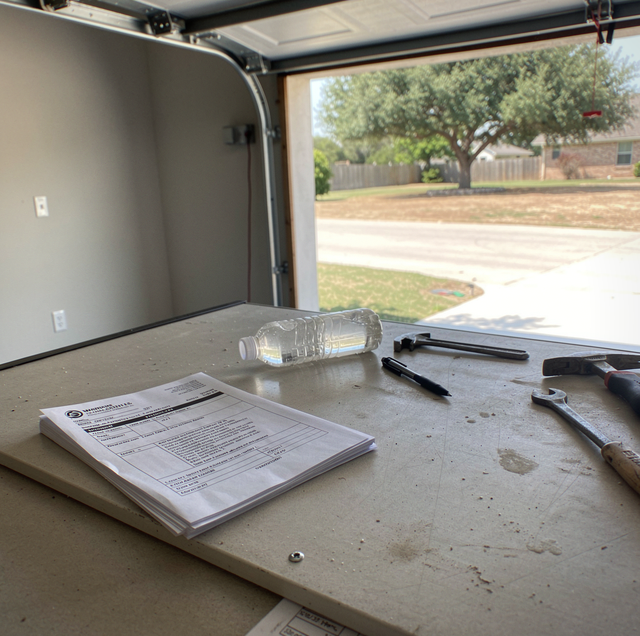
On the work order a technician fills out after an emergency call, there's a line that says more than the rest of the ticket ever will: repair status. Some nights it reads complete, fully functional. Others read temporary measure, parts on order, or stabilized, limited use only. From the driveway, the door looks the same in all three cases. What it means for the rest of your week does not.
Three Ways an Emergency Call Can End
Most emergency calls really do end in "complete". A cable snaps, a roller seizes, a section comes off its track: one part failed, the technician replaces it, tests it through several full cycles, and the door goes back to doing exactly what it did before the failure. That is the ordinary outcome, and it deserves to be said plainly first.
But not every call ends there, and the three outcomes are different in ways that matter:
Completed: The part that failed is replaced, the door is cycled and checked, and nothing about it is waiting on anything else.
Stabilized: The immediate danger is gone, and the door can still be used, but with specific precautions in place until a follow-up visit.
Parts-pending: The door is secured, but it isn't returned to normal use at all until the outstanding part is installed.
Those three words on a ticket aren't interchangeable, and which one applies to a given call turns on more than how the door looks when the truck pulls away.
What Each State Means for Using the Door
A completed repair comes with no restriction at all: opener, remote, keypad, and full travel work exactly as they did before the failure. A stabilized repair usually comes with a caution instead of a hard restriction. A track straightened enough to run true again, for example, might come with instructions to stop and call back if the door starts to bind or wander before the permanent bracket arrives. The door is still usable in the meantime; just watch it more closely than usual.
A parts-pending repair means no use, full stop. A section damaged badly enough that it won't seal or track true, common after a vehicle strike or a hailstorm, is often propped or fastened enough to stay in the opening and keep the garage weathertight, but the door itself isn't cycled again until the replacement section arrives. Sometimes that means disconnecting the opener from the door and leaving it in one position until the second visit.
Whatever manual method a technician sets up in the meantime, one caution applies without exception: the release cord is safe to use only with the door fully closed and the counterbalance intact, and it is never a way to hold a door open.
What Each State Means for the Household's Security
A completed repair restores the door to its normal security: the same opener authentication, the same lock function, the same resistance to forced entry. A stabilized repair generally keeps that security intact too, since the caution attached to it is almost always about wear or alignment, not about whether the door can be forced open. A parts-pending repair is a different case. Because the door isn't being cycled, whatever kept it secure before (a working opener, a functioning lock bar) has stopped doing that job for the moment, and restoring that function before the truck leaves is part of the same visit. That is a deliberate trade: less convenient, and only as secure as whatever was left holding the opening.
What Determines Which State a Repair Lands In
Several factors push a repair toward being stabilized or parts-pending rather than complete. One is simply whether a matching part is available at that moment, which is a separate question from how serious the failure is. A second is what fixing the immediate failure leaves standing beside it. A torsion spring replaced on a night call sometimes leaves its same-age twin in place, untouched only because it hadn't let go yet. Manufacturers commonly rate a standard residential torsion spring at around 10,000 cycles, and a longer-life spring is a separate product, specified up front and built with more steel. Door weight sets the torque a spring must supply, not its cycle count. A pair installed on the same day reaches the end of that count together, so replacing one leaves the two sides no longer sharing the door's weight as they were sized to, and the opener's drive train absorbs the difference on every trip. By the three labels above, that ticket is stabilized: the failure is fixed, the door is usable, and a condition rides with it until someone comes back.
A third factor is whether the fix can actually be confirmed before the technician leaves. A door that cycles cleanly and holds its balance across several full trips is an easy call: complete. A problem that only shows up occasionally can't be ruled out by a single clean cycle, so it's more often left stabilized with instructions to call back if it recurs.
Who Decides, and What They're Looking At
The technician on-site makes the call, and it's based on direct observation, not a guess about how the door might behave later. That means running the door through multiple complete cycles, checking that it travels the same speed and distance in both directions, and confirming that replaced hardware is torqued and seated the way the rest of the system expects. If any of that comes back uncertain (uneven travel, a bracket that won't fully seat, a part that's close enough to work but not quite matched), the convention is to call it stabilized rather than complete. The point is that a borderline case getting the more cautious label is the point, not a failure of the visit.
What a Second Visit Does and Does Not Involve
A second visit on a stabilized or parts-pending repair means installing the part that was on order, then running the same cycle-and-balance check used to call anything complete in the first place. It doesn't mean re-diagnosing the door from scratch: the cause was already identified on the first call, and the second visit exists to finish that specific job, not reopen it. It also doesn't mean the household has to track a calendar for it. What matters is whether the stabilized state is still doing what it was set up to do, holding the door secure and usable within its limit.
The clearest way to know which of the three outcomes applies to a specific door isn't how it looks from the driveway. It's what got written on the ticket before the technician left, and whether anyone asked to see it.
Frequently Asked Questions
Light and access decide this more often than skill does. A night call works from what is on the truck and what a headlamp reaches, and some repairs need the door measured against its opening, or the ceiling above the opener cleared, before anyone can close them out. A repair that would leave the door out of service for hours is also held for daylight.
Usually, and the useful limit is in cycles instead of days. The caution on a stabilized ticket describes a condition that changes with use, so a door opened four times a day reaches the follow-up in a different state than one opened twenty times. An attached garage serving as the household's main entry runs that count up quickly, which is why a door that looked fine on Tuesday can bind by Friday.
Whether a claim responds to work already done is a question for the carrier that wrote the policy, not something a repair ticket can settle. What the ticket does is fix a date and a description of what was found and done that night, a record that exists whether or not a claim is ever opened. Filing it with the door's other paperwork keeps that sequence readable later.
Not a fixed one, and the two things that set the timing sit outside the household. The first is the part's lead time, which runs on the supply side and doesn't shorten because someone calls twice. The second is exposure: temporary hardware doing a permanent part's job, with weather working on it. Fasteners loosen through daily heating and cooling, humidity finds bare steel at cut edges, and a bottom seal no longer sitting flat lets wind-driven rain under the door. A sheltered state can wait longer than an exposed one.
Three things make a ticket useful a week later. It names the outstanding part specifically instead of "a part," because "the bracket" will not get an order placed. It records what was tested and not only what was replaced, down to how many complete cycles the door was run afterward. And on a stabilized ticket, it names the trigger, the specific change that means stop using the door and call, so "watch it" isn't left to interpretation.
Two conditions account for most of them: a photo-eye catching direct glare at one hour of the day, and a bracket that has shifted just enough to sit borderline. Neither reproduces on demand, so a record of conditions beats a tally of how often it happened. Which direction the door was traveling, whether it was the first cycle of a cold morning or the tenth of a warm afternoon, and whether the sun was on the sensor side are what let the return visit recreate the fault deliberately.
Get the follow-up on the calendar before the truck leaves — Squared Away Garage Door Service closes out parts-pending tickets on Brushy Creek emergency repair calls, and takes a surviving same-age twin off the list with spring replacement in Austin. Call (512) 456-3781.
