
Lost a Garage Door Remote With Your Address? Do This First
Quick Answer: Erasing every remote and keypad from the opener's memory permanently retires the lost unit. Re-pair only the devices your household can physically account for, then check the keypad, the car, and any second receiver.
The plastic clip on that remote usually carries something written on it in permanent marker: a house number, a unit letter, sometimes a full street address next to a parking-permit sticker. It's a habit born of convenience, and it's what turns a missing visor clicker into more than a missing gadget. Whoever has it now has a working way into the garage and a note telling them where that garage is. Fixing it has a clear order, and the step that matters most comes first.
Clear the Opener's Memory Before Anything Else
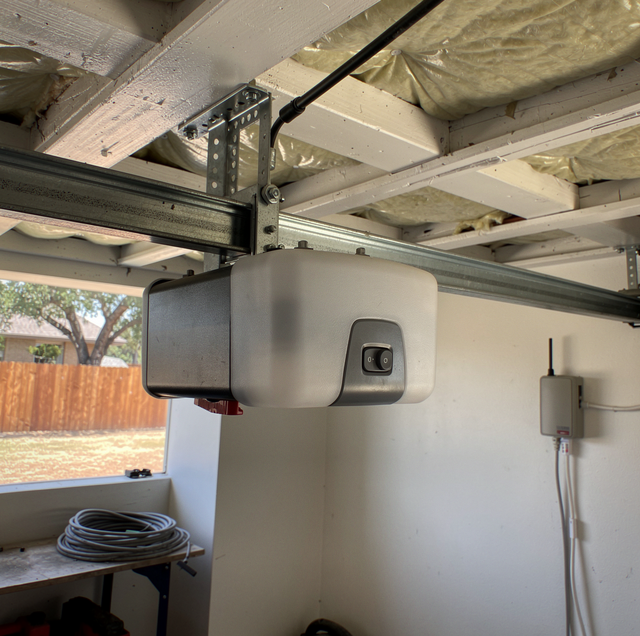
The first move isn't finding the remote or changing a code. It's telling the opener itself to forget every device that has ever been paired to it: every remote, every keychain fob, every keypad. On most residential systems, that control sits on the opener unit itself, on the motor head or the receiver housing, not on the wall panel inside the garage. Which control it is varies by brand and model year, so the owner's manual or a technician is the right place to find that part. What matters here is the order, because this is the only step that permanently removes the lost unit's ability to open anything.
There is a stopgap available while you find the manual: an opener with a console lock, sold on some units as vacation mode, shuts out every remote and every keypad code at once from the wall control while leaving that wall button working.
One condition outranks the whole sequence. If the remote went missing alongside a pried side door, a broken window, or anything else suggesting someone was on the property instead of a keyring quietly vanishing, a walk-through of the building comes first. Absent that, the memory clear is the part nothing else substitutes for, and everything after it is rebuilding.
Why a Paired Remote Stays on the List
A pairing does not decay. A remote the receiver has learned stays on its list indefinitely: it doesn't expire, it doesn't weaken with time, and adding a fresh keypad code or a replacement clicker doesn't displace it. Rolling codes defeat someone recording and replaying a signal; they do nothing about a transmitter the receiver already trusts. What the receiver holds is a list of devices it will answer, with no label, no date, and no way to read back whose is whose, which is why the practical move is to empty the list instead of hunting through it.
One consequence is worth planning around. Everything currently working stops working at the same moment: the keypad by the driveway, the fob in a partner's bag, the button trained into the second car. Doing this when nobody is about to need the door saves someone stranded in the driveway from a phone call.
Re-Pair Only What Your Household Still Holds
With the memory empty, the receiver trusts nothing, and the rebuild means adding back only what's physically in hand. Walk the property first: the visor remote in each car, any keychain remotes, any secondary unit kept by a neighbor or a cleaning service. Count them before pairing anything, and add a device only once you can see it. A remote you can't currently locate stays off until it actually turns up.
Cycle the door once from each re-paired remote and let it finish its travel, so you know the device answers and the door runs end to end. None of this calls for moving the door by hand. If a power outage later does, the limit is the same one that always applies. The release cord is safe to use only with the door fully closed and the counterbalance intact, and it is never a way to hold a door open.
The Exterior Keypad Runs on Its Own Memory
On many systems, the numeric keypad mounted by the driveway stores its access code in a location separate from the remote-transmitter list, and clearing the remotes does not automatically touch it. If that code had ever been shared with a dog walker, a delivery driver, or a past house-sitter, it needs a new code set directly at the keypad, confirmed on its own rather than assumed to be covered by the opener-wide erase. A cracked or forced keypad housing is a different repair than a code reset and deserves its own look.
Everything Else That Still Answers to That Remote
A garage remote rarely opens only one thing. A vehicle's built-in visor or mirror buttons hold a trained channel until the car's own system is told to forget it, separately from anything done at the opener.
Past the car, every other receiver on the property keeps its own memory bank. A detached workshop, a second bay with its own motor, a shed with an opener on it: each was paired on its own, and each has to be cleared on its own, and a household that has been there a while often can't say which of them that remote was ever taught. A gate operator runs the same way, except its receiver usually sits out at the entry in a weatherproof box rather than near the house, which is why it's the one that gets overlooked. None of these get fixed as a side effect of clearing the garage opener.
The Interior Door Is the Backstop
The door between the garage and the living space, ideally solid-core with a working deadbolt, is the layer that carries the most weight if any step above got missed or a device got forgotten. A cleared opener assumes the sequence was carried out correctly and nothing was overlooked; a bolted interior door doesn't depend on either being true. It's the difference between someone standing in an empty garage and someone standing in the house.
Two things undercut that layer more often than households expect. The first is a deadbolt nobody actually turns, left that way out of habit on the reasoning that the garage door is the real barrier. The second is a hollow-core slab hung there by a builder treating it as an interior passage door instead of an exterior one, which looks identical from the kitchen side and behaves nothing like it.
Where the House Stands Once the List Is Rebuilt
The address on that tag stops meaning anything the moment the receiver answers only hardware someone can put their hands on. The habit that prevents a repeat is keeping identifying information off the remote: a house number belongs on the mailbox, not stapled to the one object that also opens the door. If a household needs to tell four identical clickers apart, a colored dot or a single initial does that job without publishing where the door is, and it survives being dropped in a parking lot with nothing to say about who lost it.
Frequently Asked Questions
Usually not automatically. App-based control typically runs through a separate account login and a hub or built-in Wi-Fi module, a system a manual erase never touches. If the missing device also had that app installed and signed in, change the account password and sign that device out separately; clearing physical remotes and keypads doesn't reach an app session on its own.
An opener's receiver holds a fixed number of paired devices, and once every slot is filled, teaching it a new remote quietly pushes out the oldest one stored. Nothing announces it: the new remote works, and the displaced one just stops being recognized. That's the usual explanation for a clicker going dead the week after a replacement was added, and it's worth knowing before anyone decides the old one has a battery fault.
That's a separate problem from the opener and needs its own fix: a locksmith rekeying the affected exterior door lock. Clearing an opener's paired-device memory has no effect on a pin-tumbler house key, so treat them as two separate to-do items.
No. The pairing lives in the receiver, not in the remote. A transmitter's battery level or physical condition has no bearing on whether the receiver still trusts it, so a remote with a dead cell, a cracked case, or one that's been run over stays an active device on that list until the receiver is told to forget it.
Those go with everything else, with no need to identify or track down devices paired years before the current household arrived. The part worth doing afterward is writing the rebuilt list down: how many devices you re-paired, and where each one lives, which car, whose bag, which drawer. An inherited list can't be audited; the one you build can, and the next time something goes missing that note tells you whether anything else is unaccounted for.
Probably not. An outdoor keypad is wireless and runs on its own battery behind the flip-up cover, commonly a 9-volt or a pair of AA cells, and that battery dies with no warning: no low-power beep, no slow fade, the pad just stops answering. Heat and cold both shorten a cell's life, which is why a pad in full sun tends to need fresh cells more often than one in shade. A silent keypad is far more likely to be a dead battery than a cleared code, and the old code will still be active once power is back.
Book a technician to rebuild the paired-device list with you — Brushy Creek opener repair covers the receiver, the driveway keypad, and any second bay, while smart garage door openers trade a fixed code for access you can revoke. Squared Away Garage Door Service serves Cedar Park and Central Texas. Call (512) 456-3781.
