

Garage Door Shaking or Jerking? Here's What's Failing
Quick Answer: A garage door that shakes or jerks isn't always caused by worn rollers. Five other components — a bent track, loose hinges, an out-of-balance door, a slipped or frayed lift cable, and slack in the opener's drive chain or belt — can produce the same symptoms. To pinpoint the cause, observe whether the tremor repeats at a steady interval tied to door speed (roller), at one fixed spot in the track (track), or specifically at the start of travel (opener drive slack).
About a third of the way up, the climb turns into a shudder. Not a smooth glide, a visible tremor that travels up through the panels, sometimes hard enough to rattle a shelf bracket or make a hanging rake tap against the wall. Or maybe it's a jerk instead: the door hesitates, lurches forward a few inches, hesitates again, climbing in small steps instead of one motion. Rollers get blamed by default, mostly because they're the one part of this system a person can actually watch turning as the door moves. That guess lands right often enough to stick as the default answer. Five other parts can produce the same shake or the same jerk, though, and treating all of them as "probably the rollers" means a real chance of paying to swap a part that was never the problem.
A garage door is a system of parts moving together: rollers riding in a track, hinges connecting the panels, springs and cables carrying the weight, and an opener supplying motion at the top. Shaking and jerking are motion symptoms, and they can come from any part of that chain. Knowing what a healthy roller-and-track system feels like turns a guessing game into a five-minute diagnosis you can do from where you're standing.
How a Roller Is Supposed to Ride
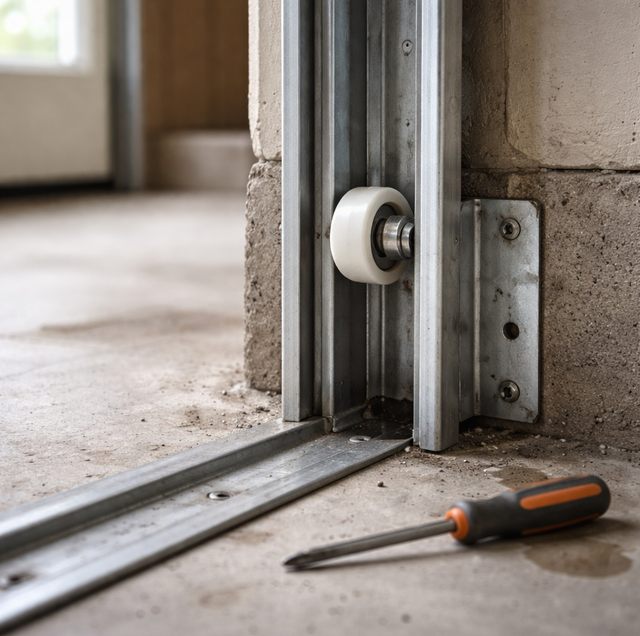
Each panel section carries roller stems, usually two per panel on a standard door, and each roller wheel sits inside a U-shaped steel track bolted to the wall and header. As the door travels, the wheel spins inside that channel the way a wheel spins on a rail: smooth rolling contact, no sliding, no chatter. The track's curve at the top guides the door from vertical to horizontal without the roller ever leaving the channel.
That smoothness depends on the roller staying round and the track channel staying a consistent width. When either drifts, the roller stops rolling cleanly and starts catching at a regular interval, once per wheel rotation, which is why roller problems tend to feel rhythmic rather than random.
The Rollers Themselves Wear Two Different Ways
Most residential doors use either nylon rollers with sealed ball bearings or older steel rollers with an exposed bearing race. They fail differently, and the failure changes what you feel.
Nylon rollers develop flat spots on the wheel, small worn patches where the round wheel is no longer round, from years of the same contact point bearing the door's weight at rest. A flat-spotted nylon roller produces a rhythmic thump once per rotation, more noticeable the faster the door travels. In advanced wear, the nylon can crack or chip at the flat spot, especially once UV exposure has made the plastic brittle, turning the thump into a harder, more irregular jolt.
Steel rollers wear differently: the bearing race pits or its grease dries out, so the wheel stays round but no longer spins freely. Instead of rolling smoothly, it skids and grabs against the track in short bursts, reading more like a grinding vibration than a clean thump, often with a metallic squeal a bad nylon roller usually doesn't produce.
Either way, a roller-caused shake tends to repeat at a steady interval tied to the door's travel speed, and it usually starts partway through the cycle rather than right at the beginning or the very end.
It Isn't Always the Roller: Five Other Places the Shake Can Start
A rhythmic tremor points toward a roller, but a jerk, lurch, or shudder can just as easily come from somewhere else in the same chain. The table below separates what you're seeing and hearing from what it actually means.
| What You Notice | Likely Cause | What's Actually Happening |
|---|---|---|
| Steady thump or vibration, same interval every cycle, worse the faster the door moves | Worn or flat-spotted roller | The wheel is no longer round (nylon) or no longer spinning freely (steel bearing), so it catches once per rotation |
| Shudder concentrated at one point in the track, sometimes a scraping sound, one side more than the other | Bent or misaligned track | A dented or twisted section of track narrows the channel, so the roller binds every time it passes that spot, regardless of roller condition |
| Rattling or a loose, wobbly feel at the panel joints; door looks less rigid overall | Loose or worn hinges | Hinge pins wear oval instead of round, or hinge bolts have backed out, so adjoining panels shift against each other instead of moving as one unit |
| Door lurches or fights itself through the whole travel, opener strains audibly | Out-of-balance door | The springs no longer match the door's weight, so the opener does more of the lifting than it was built for and stutters under the extra load |
| Door hangs or sags crooked on one side, jerk is worse on that specific side, sometimes visibly off level even sitting still | Slipped or frayed lift cable | One side's steel cable has come off its drum groove or is fraying under load, so that corner of the door is no longer traveling in step with the other |
| Jerking specifically at the very start or end of travel, opener makes a slapping or clicking sound before movement begins | Slack in the opener's drive chain or belt | A stretched chain or loose belt has to take up play before it transmits force, so the door jerks forward the instant the slack runs out |
Only one row on that table is actually about the roller. A door that shakes evenly, at a steady interval, through most of its travel is a strong roller signal. A door that jerks at one repeatable spot, or specifically at the very start of the cycle, is telling you to look somewhere else first.
Telling the Other Five Apart
A bent track usually traces to an impact, a car bumper clipping the bottom section, a ladder leaned against the rail, or a section worked loose from the wall. Expansive clay soil under a slab can also gradually shift a door frame over months, walking a track out of true with no single impact at all. Because the narrowing sits at one fixed point, the shudder repeats there every cycle: a worn roller shakes everywhere along its rotation, a bent track shakes at one location no matter which roller passes through it.
Loose hinges feel more like a rattle than a shake, which is why they're easy to miss. Hinge pins are round when new; years of panels flexing against them wear the pin oval, letting adjoining sections rock against each other instead of moving as one rigid plane. Put a hand flat across two adjoining panels while the door runs: a healthy hinge transfers almost no independent motion, while a worn one lets you feel each panel move a beat apart.
An out-of-balance door produces a jerk that feels like the whole door is straining rather than one part catching. The opener sounds like it's working harder than usual, sometimes with an audible groan or a garage light that flickers when the motor draws extra current, and the jerk happens through most of the travel rather than at one spot. A door lifted by hand to waist height, opener disconnected, should stay roughly where you put it; one that drifts down or shoots up confirms the springs, not the rollers, are the real problem.
A slipped or frayed lift cable produces a jerk that can be mistaken for an out-of-balance door at first, but the tell is asymmetry: one corner sags lower than the rest, and the jerk is worse on that specific side rather than through the whole width of the panel. Each side of the door has its own steel cable running from the bottom bracket up to a drum on the torsion shaft, and the two drums are supposed to wind in step. A cable that has slipped off its drum groove, often right after a spring lets go, and the sudden loss of tension leaves the cable briefly slack, no longer travels in sync with its partner, so that corner of the door moves differently than the rest of the panel. A cable can also fray under load without coming off the drum at all, shedding strands and losing a little tension with each cycle before it lets go outright. Neither a slipped nor a fraying cable is something to keep cycling through the opener; the door should stay parked until a technician re-seats or replaces it.
Drive-chain or belt slack inside the opener is the one cause that isn't about the door at all. Over years of cycles, a chain stretches, and a belt loses tension, leaving a small amount of play the motor has to take up before force reaches the door. That shows up as a jerk right at the start of opening, sometimes with a loud clack as the slack snaps taut, and it's adjustable at the opener's tensioning bracket rather than anything you'd fix at the door itself.
A Familiar Comparison
The rhythmic thump of a flat-spotted roller feels like a shopping cart with one wheel that's developed a flat side: smooth for most of the roll, then a distinct bump at the same point every rotation, worse the faster you push. A bent track behaves more like a cart wheel catching on one cracked floor tile: the bump shows up at the same physical spot no matter which wheel is there. Rhythmic-and-everywhere versus located-at-one-spot tells a roller problem from a track problem without opening anything up.
What Makes These Parts Wear Faster
None of these six causes is purely random. Heat and UV exposure make nylon rollers and weather seals more brittle, so a flat spot is more likely to crack instead of wearing smooth. Humidity promotes rust on steel roller bearings, hinge pins, and cables, adding friction that turns a quiet roll into a grind. Storms and hail can dent a track section directly, and homes that use the garage as the main entry rack up cycle counts well above a door used occasionally, accelerating wear on rollers, hinges, and drive components. None of this runs one direction only: heat stresses springs and motors through the warm months, while cold makes steel more brittle and grease thicker in winter, so a shake that shows up "out of nowhere" is usually wear that's been building all year.
When to Stop Watching and Call a Technician
A shake or jerk that's steady, predictable, and not getting worse week to week is reasonable to observe and mention at your next maintenance visit. A few signs mean stop using the opener and get a same-day look instead: a visible gap where a roller has left the track, a bent rail, a frayed or slack cable, or a jerk that's clearly worsened over the last few cycles. Springs and cables under tension can cause serious injury if handled without the right tools; diagnosing which of these six causes applies is safe from where you're standing, but adjusting the track, springs, or tensioning bracket is not a do-it-yourself repair.
Frequently Asked Questions
A standard door usually carries two rollers per panel, so an eight-foot sectional with four sections has eight rollers total, sometimes more on taller doors. A single bad roller matters: adjoining panels are pinned together by hinges, so one wheel catching at its flat spot transmits a jolt into the panels on either side of it, and the shake you feel two sections away can trace back to one worn wheel.
Sealed-bearing nylon rollers are commonly rated for around 10,000 open-close cycles under normal use. For a two-car household opening the door two or three times a day, that works out to roughly ten years; for a garage used as the main entry, with six to eight cycles a day, the same roller reaches its rated life in about four. Cycle count, not calendar age, is the better predictor.
Lubricating the roller stems, hinges, and track, never the plastic wheel itself, with a spray-on lithium or silicone-based garage door lubricant can quiet a mild grind from a drying steel bearing, but it won't fix a flat spot or a cracked nylon wheel. A household oil used as a long-term lubricant attracts more dust into the bearing over time. If the shake returns within days of lubricating, the part needs replacing.
A jackshaft operator, mounted on the side wall and driving the torsion shaft directly instead of pulling a trolley along an overhead rail, removes the chain-and-belt-slack cause entirely, since there's no horizontal rail to develop play in. The other five, roller wear, a bent track, loose hinges, imbalance, and a slipped or fraying cable, behave the same regardless of opener style, since a jackshaft still turns the same torsion shaft, drums, and cables the trolley system does.
With the opener's manual release cord pulled and the door fully closed, you can grip an accessible roller wheel with a gloved hand and spin it. A healthy roller spins freely for a few full rotations before slowing on its own; one that stops dead after a quarter turn, or grinds and catches as it spins, confirms a failing bearing without needing to watch the door move at all. Skip this check on any roller near a spring or cable that looks damaged.
A technician will usually check every roller during a service call, not just the one that's audibly failing, because rollers installed at the same time tend to reach the end of their cycle life within a similar window. Replacing only the worst one is a valid short-term fix, but a second roller often starts the same flat-spot pattern within months if it was already close to worn.
Reading the Pattern, Not Just the Symptom
A shake or a jerk is information, not just an inconvenience. Where it happens in the cycle, whether it repeats at a fixed interval or a fixed spot, and what the opener sounds like while it's happening all point toward one of six parts. Rollers cause plenty of these, but far from all of them, and telling the difference first means the right part gets fixed on the first visit.
Get the shake pinned to one component before it becomes two — a door that jerks through the curve is usually asking for off-track repair in Round Rock or a fresh set of rollers and hinges, and Squared Away Garage Door Service can tell which on the first visit. Call (512) 456-3781.
